


1 / 4
高取城跡(たかとりじょうあと)
Stone walls surviving on a mountaintop 583 m above sea level. One of Japan's three great mountain castles.
These castle ruins stand on the summit of Mt Takatori (about 583 m), in Takatori Town southwest of Asuka Village. All the buildings have gone; only the stone walls remain.
When you reach the top, level terraces surrounded by trees appear one above another, edged by tall stone walls. That so much stone was piled up in the middle of a mountain is hard to believe at first sight.
Along with Bitchū Matsuyama Castle (Okayama Prefecture) and Iwamura Castle (Gifu Prefecture), it is counted as one of Japan's three great mountain castles. It is one of the largest mountain castles in the country, and its stone walls run for a total of about 3 km.
Its history begins in the Nanboku-chō period (1336–1392). The first castle is said to have been a mountain fort built by the Ochi clan, who were based in this area.
Its appearance changed greatly at the end of the Sengoku (Warring States) period. Honda Toshihisa, a retainer of Toyotomi Hidenaga, took over and converted the medieval mountain fort into an early modern castle with stone walls and a keep.
In the Edo period (1603–1868) the Uemura family became its lords, and it remained the seat of the Takatori domain, assessed at 25,000 koku, until the end of the shogunate. Few castles kept a keep on a mountaintop through the whole Edo period.
The buildings were removed under the castle abolition order of 1873. What remained are the stone walls you see today. The site was designated a national Historic Site in 1953.
A folk song about the castle has been handed down.
"Tatsumi Takatori / yuki ka to mireba / yuki ni arazu shite / Tosa no shiro" — "To the southeast, Takatori: is that snow I see? It is not snow at all, but the castle of Tosa."
It means that, seen from the direction of the castle town, the white-plastered buildings on the mountain shone like snow. Tosa was the name of the castle town, and it survives today in the Tosa Kaidō street in Takatori Town.
Look up at the mountain from the same place today, and the castle ruins are hidden by trees.
For anyone walking here from Asuka Village, there is something on the way up that should not be missed.
Beside the site of the Second Gate stands a stone figure known as a saruishi (monkey stone). It belongs to the same group as the Saruishi at the Tomb of Princess Kibihime in Asuka Village and is thought to have been brought from Asuka.
It was probably one of the stones gathered as building material when the castle was built. A stone from the Asuka period, whose purpose no one knows, was carried up the mountain a thousand years later to become part of a castle. In this land, stones have been reused like that.
In the castle's stone walls themselves, there are places where stones from kofun (ancient burial mounds) appear to have been reused.
The castle is outside Asuka Village, in Takatori Town. From Kintetsu Tsubosakayama Station, walk along the Tosa Kaidō to the trailhead; it takes about 2 hours on foot to reach the main enclosure, with a climb of about 450 m.
This is a mountain trail. There are no vending machines or toilets along the way. Wear comfortable shoes and bring water. It gets muddy after rain.
By car, you can drive up a forest road beyond Tsubosaka-dera Temple to near the ruins. However, the road is narrow, and in places it is hard for two cars to pass.
The site is especially known for fresh spring greenery and autumn leaves. Because the trees are dense, the view is limited in summer; in winter the leaves fall and the stone walls are easy to see.
It is only a few kilometres in a straight line from central Asuka, but you have to cross the mountains. If you walk there and back, allow half a day to a full day.
Published
NEARBY
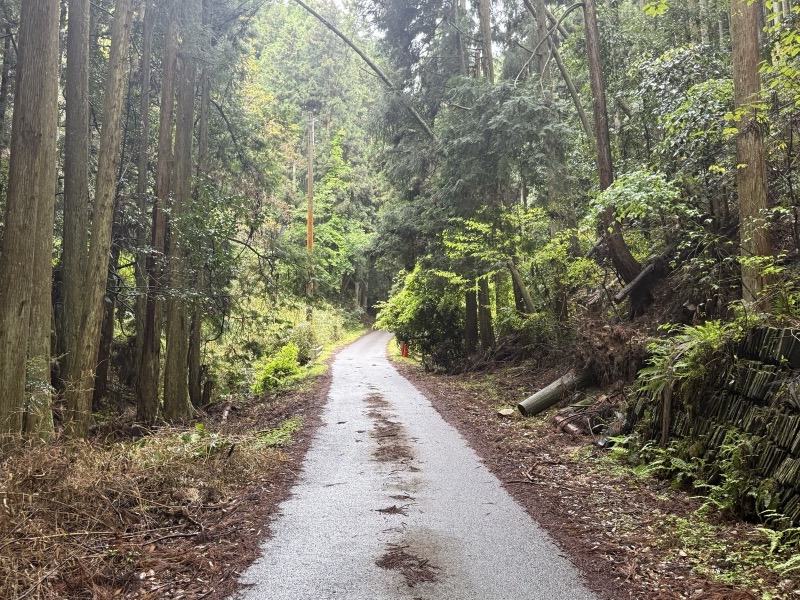
芋峠
A pass on the old road linking Asuka and Yoshino. Prince Ōama is said to have crossed it.
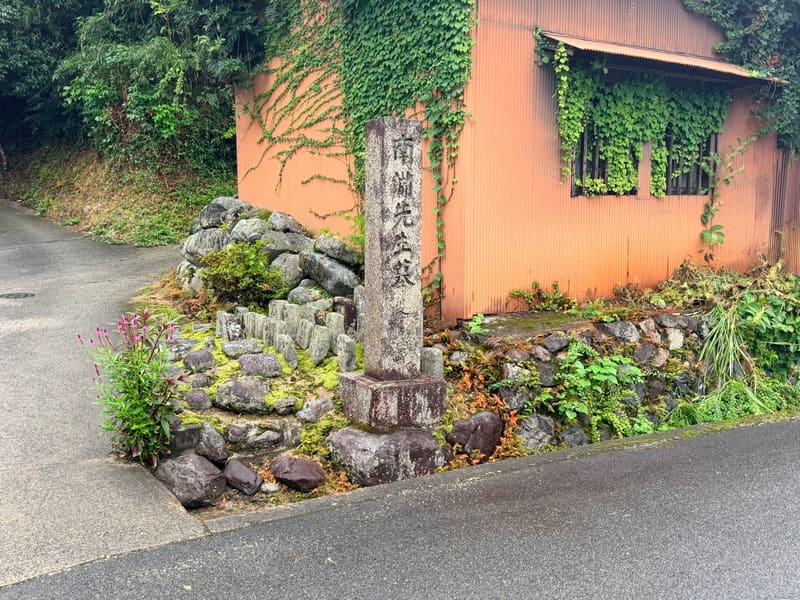
南淵請安墓
A small mound said to be the grave of a scholar who returned from Sui-dynasty China. Prince Naka no Ōe and Nakatomi no Kamatari came here to study with him.
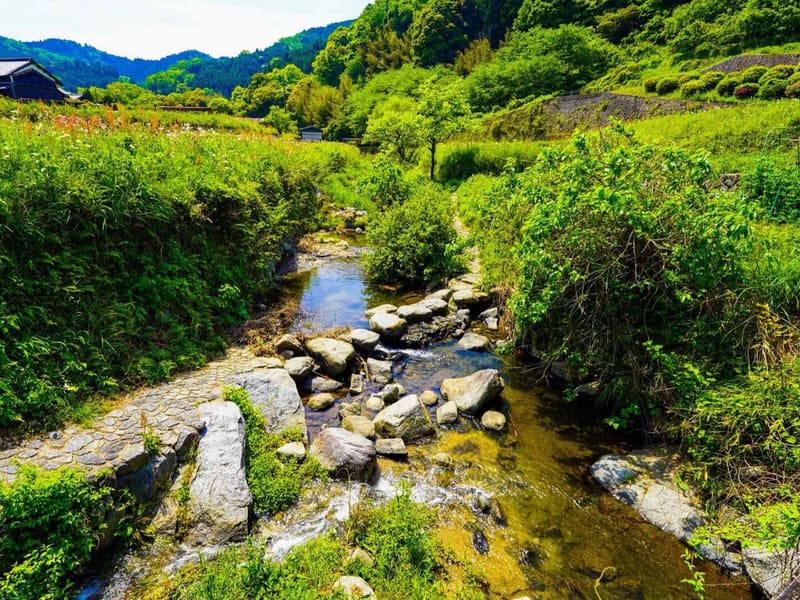
飛鳥川の飛び石
No bridge, just stones set in the riverbed to hop across. A crossing often linked with a poem from the Man'yōshū.