


1 / 3
飛鳥稲淵宮殿跡(あすかいなぶちきゅうでんあと)
A mid-7th-century site on the left bank of the Asuka River where buildings stood in a neat formation. It is considered a candidate for a temporary palace.
Walk south from Ishibutai Kofun and you come to an open area on the left bank of the Asuka River. Apart from a stone marker inscribed "Historic Site: Asuka Inabuchi Palace Site," there is only an open space and some trees. Yet a group of large buildings stood here in the mid-7th century.
Excavations begun in 1976 found four buildings with posts set directly in the ground. At the centre were two main halls lined up north to south, and on their east side two side halls aligned with them.
The main hall was a large building with eaves on all four sides, estimated at 24.6 m wide and 10.2 m deep. The rear hall and the side halls also had eaves on the side facing the main hall. The courtyard enclosed by the buildings was paved with large cobblestones.
A matching side hall is thought to lie on the unexcavated west side of the main hall, allowing the buildings to be reconstructed in a U-shaped layout. Such a regular layout and stone paving are shared with the cores of palaces, so the site is thought to have been an emperor's palace or the residence of a member of the imperial family.
The finds were pottery from the mid- to late 7th century and inkstones. No roof tiles were found, which means the buildings were post-built structures without tiled roofs.
According to the Nihon Shoki (Japan's oldest official chronicle, compiled in 720), in 653, after the Taika Reforms, Prince Naka no Ōe and others returned from Naniwa to Asuka and for a time occupied the Asuka Kawabe Temporary Palace (Asuka no Kawabe no Karimiya). This site is considered a strong candidate for it.
It was designated a national Historic Site in 1979, and the designated area has since been extended twice. It now covers 12,750 square metres. Today it is covered with rice fields and grass, and the remains of the buildings lie underground.
Published
NEARBY
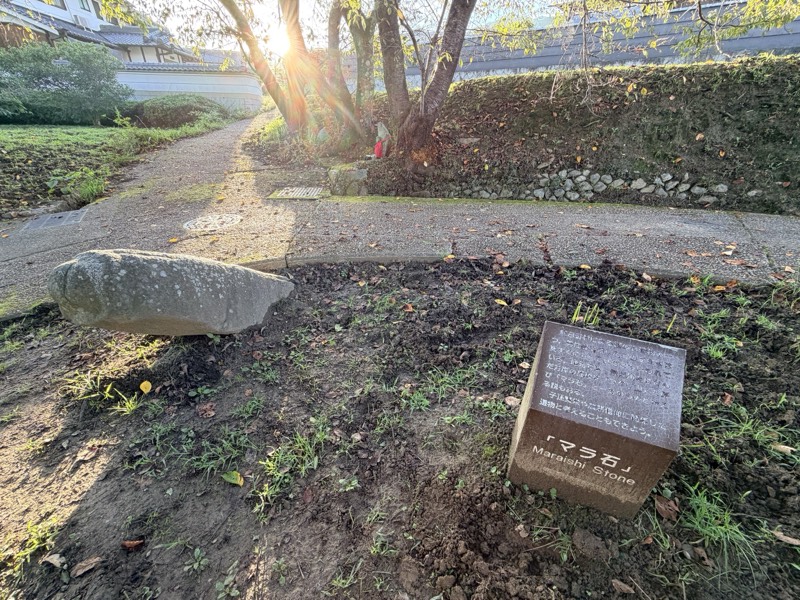
マラ石
A phallus-shaped stone lying by the roadside. One theory pairs it with "Fuguri-yama" on the opposite bank.
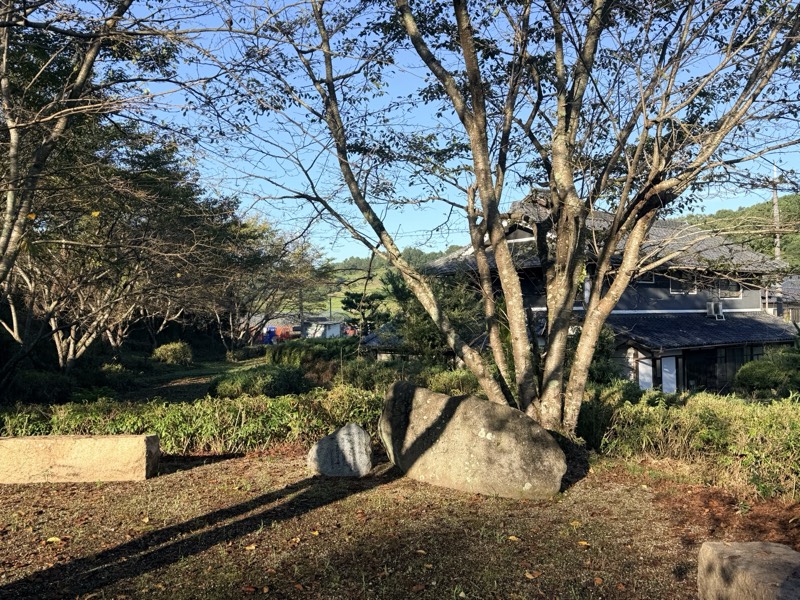
坂田寺跡
The family temple of the clan of Kuratsukuri no Tori, maker of the Asuka Daibutsu. One of Asuka's oldest temples, it was also a nunnery.
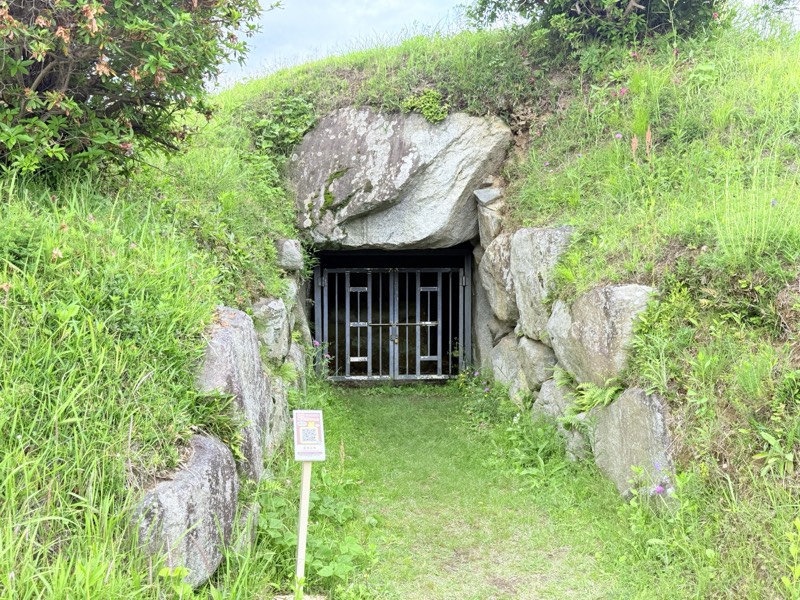
都塚古墳
A square burial mound built of stepped stone, like a step pyramid.