
Published
Red runs along the edges of the rice fields, as straight as if drawn with a ruler. It did not grow there on its own. People carried the bulbs and planted them.
In late September the rice fields of Asuka are suddenly edged in red. The rice has ripened to gold, and red spider lilies (higanbana) line the borders between the fields. It is the busiest season of the year.
Look closely, though, and you will notice that they bloom in a curious way.

Not a single one grows inside the fields. They run like lines only along the tops of the ridges (the narrow earth banks between paddies) and the edges of the water channels.
A wildflower ought to scatter its seeds on the wind and come up here and there. The red spider lily, however, never strays from the line.
The reason is simple: people planted them.

The bulbs of the red spider lily contain an alkaloid called lycorine. Eaten, it is a poison that causes nausea and diarrhoea.
This made the plant useful for the ridges. When moles or mice burrow into a ridge, water drains out through the hole and the field dries up. Lining the ridge with poisonous bulbs made it less likely to be dug up.
On top of that, the densely packed bulbs bind the soil and help keep the ridge itself from collapsing.
In other words, a line of red spider lilies is closer to a farm tool than a flower bed. The beauty was a by-product, not the aim.
The flower has another unusual trait.
Red spider lilies in Japan do not set fruit. They are triploid, with three sets of chromosomes, and cannot produce seeds. The only way they multiply is by their bulbs dividing.
That means every red spider lily in Japan is the result of bulbs being split and carried somewhere. Genetically they are almost identical: all of them are, in effect, clones of the same plant.
Unable to spread on the wind, they cannot leave the ridges. This is why they form lines. They exist only where people have taken them.

The red spider lily has no leaves when it is in flower. If you look carefully at the photo, the long thin leaves around the red flowers belong to the rice and other grasses.
Only after the flowers have finished does a cluster of thin leaves come up from the ground. Those leaves stay green all winter, photosynthesising, and wither in early summer. Then in autumn a bare, leafless stem shoots up and flowers.
The leaves never see the flowers, and the flowers never see the leaves. For this reason the plant is also called ha-mizu hana-mizu, "leaves unseen, flowers unseen".
For farmland this works out neatly. From spring to summer, while the fields are flooded and the rice is growing, the lily rests underground. In autumn and winter, after the harvest when the fields have dried, it spreads its leaves and stores nourishment in the bulb. Its season never clashes with the rice.
The red spider lily has a great many other names. It is said that if you collect all the regional names, there are more than a thousand.
Manjushage comes from the Buddhist scriptures and means a flower that blooms in the heavens. On the other hand, names such as shibitobana (dead person's flower), yūreibana (ghost flower) and jigokubana (hell flower) are found in many regions.
So many of the names are ominous because the plant was often grown around graveyards, and because it is poisonous. The names were probably also a way to stop children picking it.
It was planted in graveyards for the same reason as on the ridges: in the days of burial in the ground, it kept animals from digging up the graves.

I wrote that the plant is poisonous, but the poison dissolves in water.
If the bulbs are ground and soaked in water again and again, the poison leaches out and starch is left behind. There are records from many parts of Japan of people surviving famines by eating this. Plants like this are known as famine foods.
One view holds that the reason they were planted in such numbers on ridges and in graveyards, places where no farmland had to be given up, was to keep an emergency food supply there.
Poisonous, so animals stay away; edible, if you take the trouble. As a store to be dug up only in times of hunger, it is well designed.
The red spider lily is native to China. When it reached Japan is not clear, but one theory says the bulbs were brought in along with rice farming. Since it is a flower of the paddy ridges, it is natural to think it came together with the rice fields.
The Man'yōshū (Japan's oldest anthology of poetry) contains a poem that may refer to this flower.
Michi no he no / ichishi no hana no / ichishiroku / hito mina shirinu / aga koizuma wa. "Like the ichishi flowers by the roadside, standing out so plainly, everyone has come to know of my beloved wife." The poem is by Kakinomoto no Hitomaro: just as the ichishi flowers stand out clearly by the road, his wife has become known to everyone.
What flower the ichishi was has never been settled. The red spider lily is considered the strongest candidate, but there are also theories for itadori (Japanese knotweed) and gishigishi (Japanese dock), among others.
Still, told of a flower that stands out plainly by the roadside, it is not much of a stretch to picture the red spider lily.

The best time is from late September to early October. The flowers last only about a week, and the timing shifts by a few days from year to year.
The best-known spot is the Inabuchi rice terraces, where a scarecrow contest is held at the same time of year. Walking down from Asakaze Pass, which overlooks the terraces, you see red lines stacked one above another, terrace by terrace.
They also bloom quite ordinarily along the Asuka River and on the narrow ridge paths between villages. Even if you avoid the crowded spots, you will find the same flowers lined up in the same way.
The ridges are farmland. Stepping into the lines damages the bulbs. Please enjoy them from the road.
Every year at this time, countless photos of Asuka are taken: ripe rice, and red running along its edges. It is sometimes described as a scene you can see nowhere else.
But those red lines were not made by nature. Someone carried the bulbs and set them out one by one to protect the fields. Handed down through generation after generation, they became lines.
The terraces, the ridges and the red spider lilies all survive because people have kept tending them. If those hands stop, the lines will disappear.
The red of Asuka in autumn is a landscape, and at the same time a trace of farm work.
RELATED SPOT
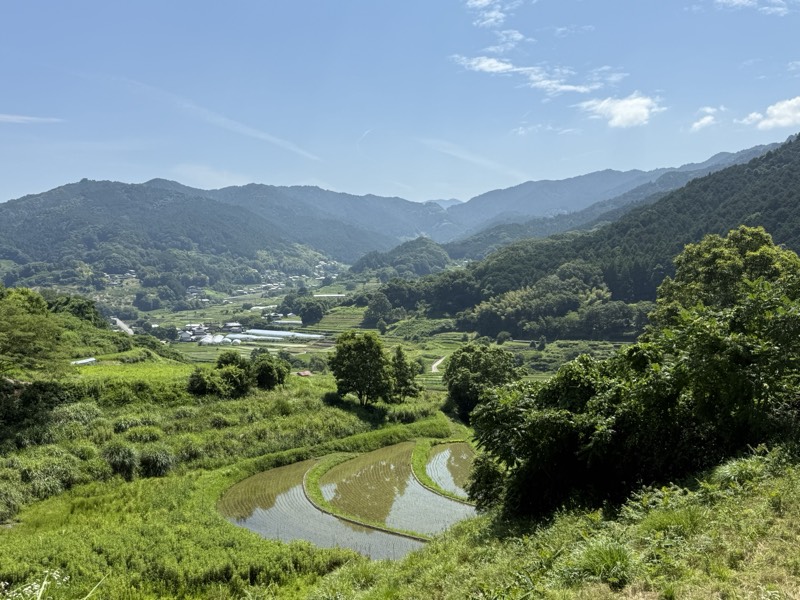
稲渕の棚田
One of Japan's 100 finest terraced rice fields. In autumn, giant scarecrows appear.
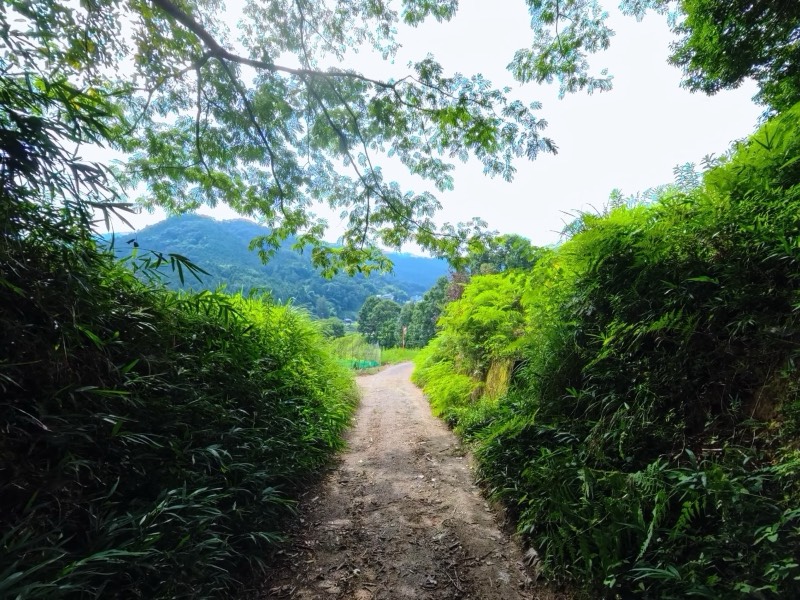
朝風峠
A pass overlooking the Inabuchi terraced rice fields, reached by a narrow path through bamboo thickets.
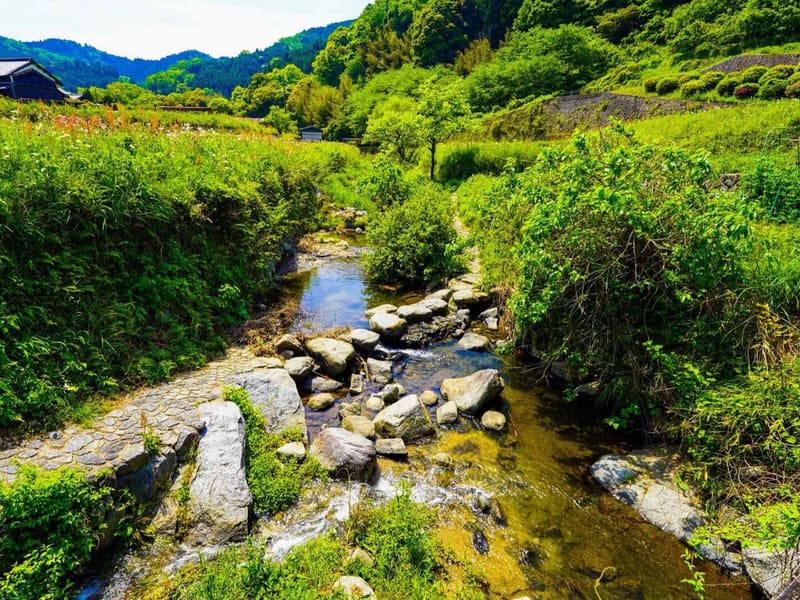
飛鳥川の飛び石
No bridge, just stones set in the riverbed to hop across. A crossing often linked with a poem from the Man'yōshū.
RELATED COLUMN
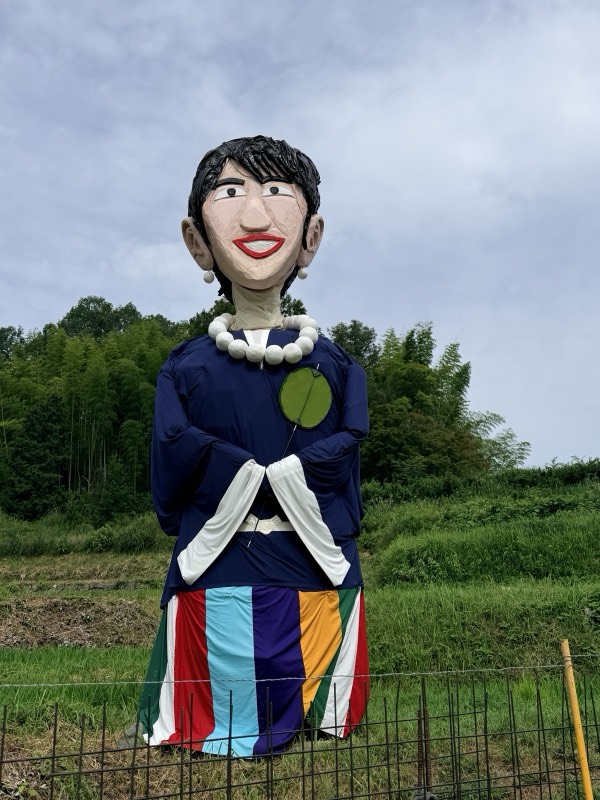 Jumbo Scarecrows: That Year in Japan, Standing in the Rice TerracesEvery autumn, a scarecrow so big you have to look up at it appears in the Inabuchi terraced rice fields. Its…
 Spring Flowers at Your Feet in Asuka: Most of Them NewcomersSmall flowers bloom along the roadsides and the ridges between rice paddies. Once you know their names, your…
 Rice Terraces Full of Chuckles: The 31st Scarecrow ContestThe theme of the 2026 scarecrow contest is "Kusu", the Japanese sound of a stifled chuckle. A village just…