
Published
Small flowers bloom along the roadsides and the ridges between rice paddies. Once you know their names, your walk looks different. Yet many of them did not exist in this village in the Asuka period.
Spring in Asuka is a season of flowers you look up at: cherry blossoms, peach blossoms, the evening illuminations at Ishibutai. But just as many flowers are blooming at your feet.
At the edges of paddy ridges, in the cracks of stone walls, at the corners of car parks. Here are names for a few of the flowers you may have been walking past without knowing what they are.

White to pale pink petals as fine as thread, with a yellow centre. This is the spring flower you see most often on paddy ridges and roadsides.
It is often confused with the very similar annual fleabane (himejoon), but there are a few clues for telling them apart.
One is the buds. Philadelphia fleabane buds droop, hanging their heads, while annual fleabane buds point upwards. Another is the stem: snap it and Philadelphia fleabane is hollow inside, while annual fleabane is filled with white pith. They also bloom at different times: Philadelphia fleabane from April to June, annual fleabane from June onwards.
This flower is a native of North America and arrived in Japan in the Taishō period (1912–1926). Brought in as an ornamental plant, it escaped into the wild. In other words, not only the people of the Asuka period but even people in the Meiji period (1868–1912) never saw it.

A small blue flower that starts blooming around the end of February. It is less than 1 cm across. It opens when the sun shines and closes when it goes behind a cloud.
Each flower blooms for just one day. It opens in the morning and by evening it has wilted and dropped. They look as though they bloom in clusters because a different flower opens every day.
The Japanese name comes from a native relative, inunofuguri, whose fruit is said to look like a certain part of a dog's anatomy; ōi, "large", was added because this species is bigger. It is a name hard to imagine from the flower itself. Perhaps because of the gap, it is also known by another name, hoshi no hitomi, "eyes of the stars".
This flower, too, came from Europe. It was first recorded in Japan at the start of the Meiji period (1868–1912). Today the native inunofuguri has become the harder of the two to find.

Deep blue-violet flowers that look like beads stacked on top of one another. Because they resemble a bunch of grapes, they are called grape hyacinths in English.
They are bulbs native to the Mediterranean region and came to Japan as garden plants. Planted in gardens and flowerbeds, they multiply by their bulbs and also spread from fallen seed. The ones you see on roadsides and at the edges of paddies have escaped this way.
The urn-shaped flowers open in turn from the bottom up. Look at each one up close and you will see that its mouth is rimmed with white.

Deep pink flowers that spread out to cover the ground. The Japanese name contains the word sakura, "cherry", but it is not related to cherries. It is a plant of the phlox family (Polemoniaceae), native to eastern North America.
It has five petals. The colour deepens towards the centre, where tiny stamens peep out. The leaves are as thin as needles, and when it is not in flower it forms a carpet of green.

It is often planted on slopes, and not only for its looks. Its roots spread well and hold the soil in place, so it doubles as protection for embankments. In Asuka, too, you can see it on roadside banks and at the foot of stone walls.
All four of the flowers so far came from elsewhere.
So what did people look at in spring when the palaces stood on this land? The clue lies in the Man'yōshū (Japan's oldest anthology of poetry).
Iwabashiru tarumi no ue no sawarabi no moeizuru haru ni narinikeru kamo. "Above the waterfall rushing over the rocks, the young bracken is sprouting: spring has come at last." This poem is by Prince Shiki. Bracken has sprouted beside water rushing over rocks, and from that he knows spring has arrived. He marks spring not by flowers but by new shoots.
Among flowers, violets appear in the poems. Haru no no ni sumire tsumi ni to koshi ware so no o natsukashimi hitoyo nenikeru. "I came to the spring fields to pick violets, and the fields were so dear to me that I slept there the whole night." This poem by Yamabe no Akahito says that he came to pick violets, found the fields so pleasant that he spent the night there.
Others include plum, cherry, yamabuki (Japanese kerria), wisteria and katakuri (dogtooth violet). The spring flowers in the Man'yōshū are all ones that can still be seen in the hills and along the rivers. But among the flowers that catch your eye by the roadside, the newcomers from abroad now far outnumber them.
The line-up of flowers at your feet, then, has been almost entirely replaced over the last hundred-odd years.
While we are at it, the fields of rapeseed blossom that seem to symbolise spring in Asuka, and the red spider lilies lining the paddy ridges in autumn, are not ancient scenery either. The rapeseed is cultivated, and the spider lilies were planted to protect the ridges. The paddies themselves are a landscape that people have kept remaking.
Perhaps this is a place where it is harder to find something that has not changed.
And yet, walking through the fields, noticing a flower, checking its name or picking some to take home: that act itself has not changed since the day Akahito went out to pick violets. Only the line-up of flowers has changed.
To look for flowers at your feet, an easy route is from the foot of Amakashi Hill along the Asuka River towards the Inabuchi rice terraces. They gather on sunny banks and on the ridges between paddies.
Persian speedwell blooms from late February to April, muscari and moss phlox in April, and Philadelphia fleabane from April to June. Walk the same path a month apart and you will find different flowers in bloom.
The paddy ridges are farmland. Please enjoy the view from the road and do not walk into the fields.
RELATED SPOT
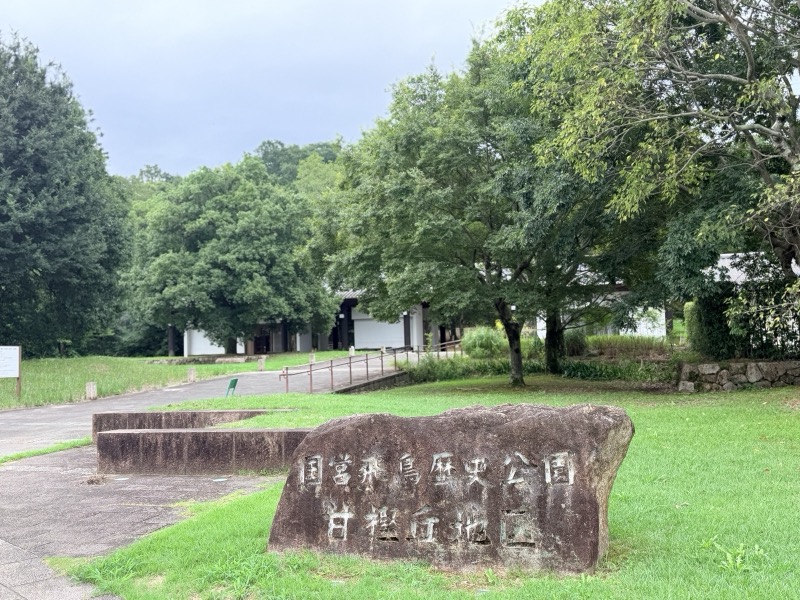
甘樫丘
A hill with views over all of Asuka, said to have been the site of the Soga clan's residences.
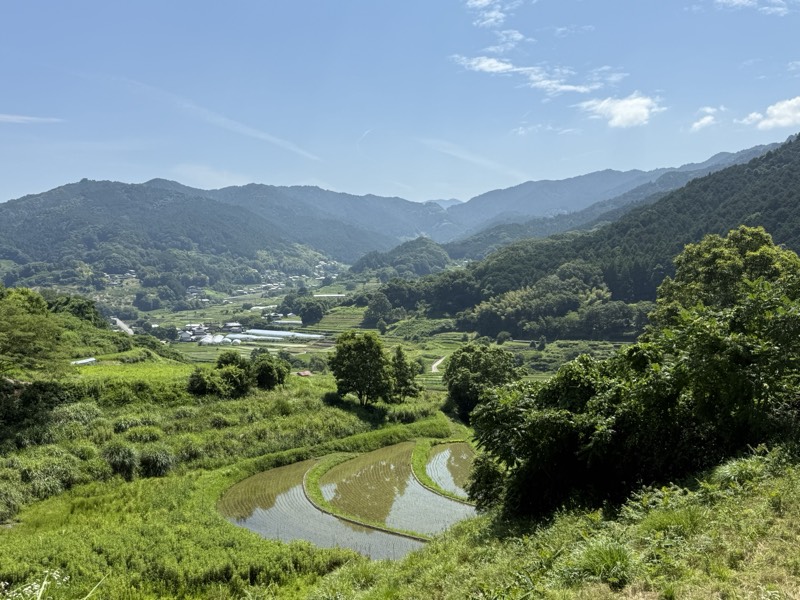
稲渕の棚田
One of Japan's 100 finest terraced rice fields. In autumn, giant scarecrows appear.
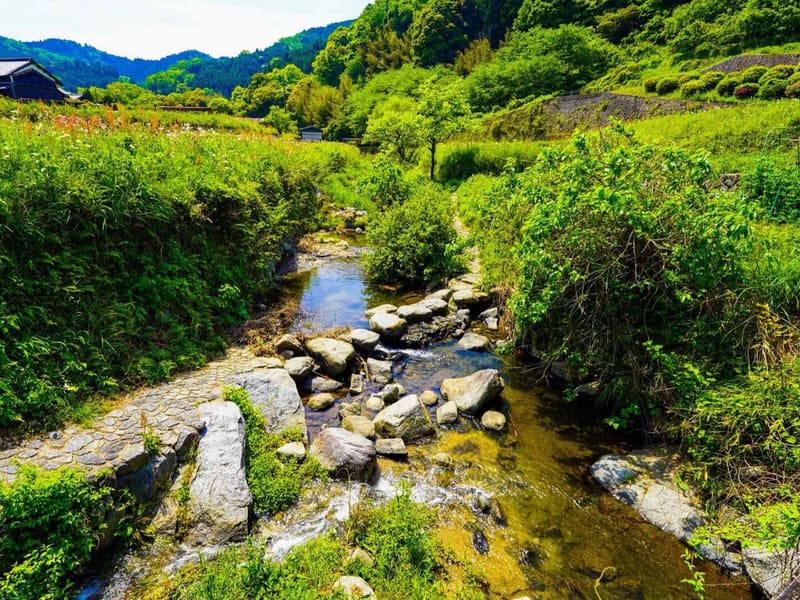
飛鳥川の飛び石
No bridge, just stones set in the riverbed to hop across. A crossing often linked with a poem from the Man'yōshū.
RELATED COLUMN
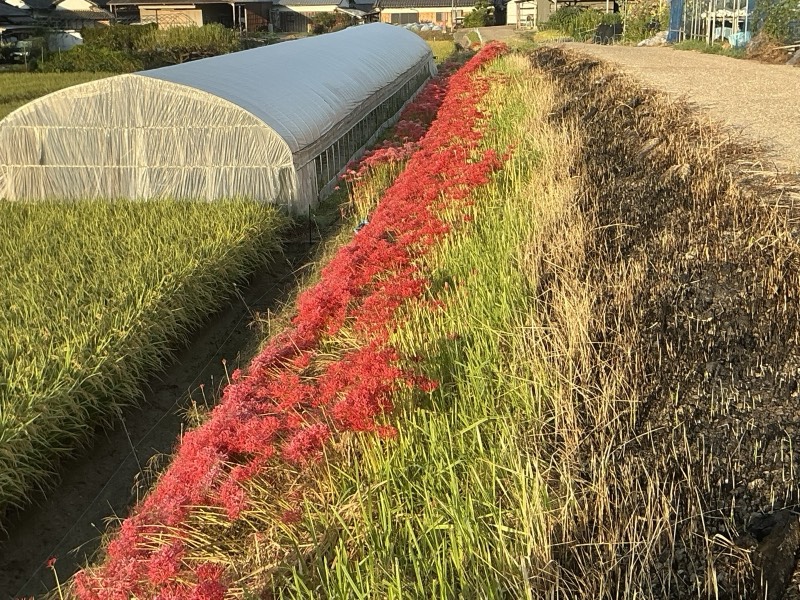 Why do red spider lilies bloom in single lines along the paddy ridges?Red runs along the edges of the rice fields, as straight as if drawn with a ruler. It did not grow there on…
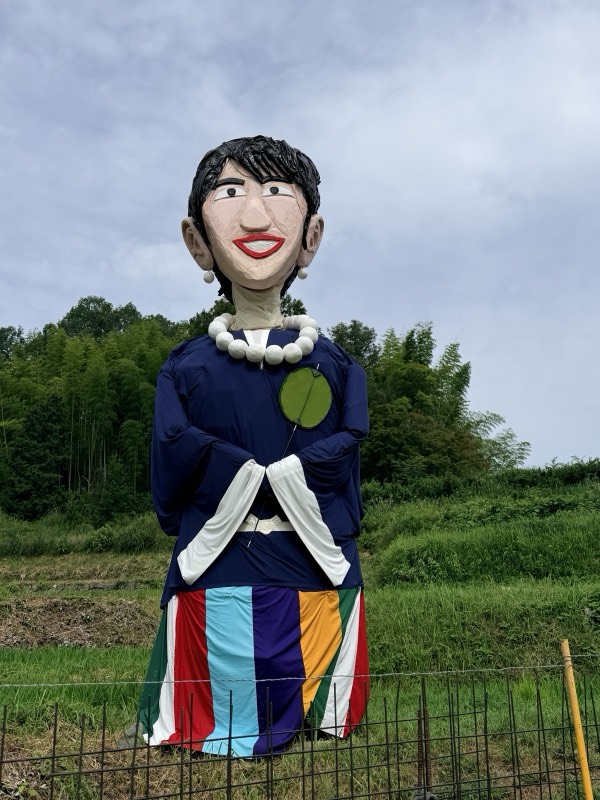 Jumbo Scarecrows: That Year in Japan, Standing in the Rice TerracesEvery autumn, a scarecrow so big you have to look up at it appears in the Inabuchi terraced rice fields. Its…
 Man'yōshū Basics: Sōmon, Banka and Zōka, Hanka and Answering PoemsWalk around Asuka and you meet poems from the Man'yōshū everywhere. Here is a summary of what makes them more…