
Published
Those who lie are scalded; the honest come away unhurt. According to the Nihon Shoki, this trial was held on Amakashi Hill. The rite survives to this day at Amakashi-niimasu Shrine.

In the section of the Nihon Shoki (Japan's oldest official chronicle, compiled in 720) on Emperor Ingyō, there is this story.
At the time, people's claims to clan names (uji) and hereditary titles (kabane) had fallen into disorder. People of low standing claimed to belong to noble lineages and changed their names as they pleased. It had become impossible to tell who belonged to which family, the story goes.
The emperor set out to put this right. But there were no documents to prove anything. How could anyone confirm whether a claim was true?
The answer was kukatachi.
A kukahe, a cauldron for boiling water, was set up on Amakashi Hill. People were gathered there and made to put their hands, one by one, into the boiling water.
It was believed that those who told the truth would come to no harm, while the hands of those who lied would be scalded.
Some accounts say a pebble was placed at the bottom of the cauldron for each person to pick out. Another explanation says a cauldron of boiling mud was used. Either way, the principle was the same: people were made to touch something hot, and judged by the result.
The Shoki says that when this was carried out, people were filled with awe and corrected their claims, and no one made false claims any more.
To modern eyes, anyone who puts a hand into boiling water will be scalded, whether they are lying or not.
But this trial did not assume that people were doing the judging. It assumed that the gods were. The gods would reveal what humans could not know, and the water in the cauldron was a tool for receiving their answer.
If so, the method worked before the question of burns ever arose. Say "Then put your hand in the cauldron" in front of people who truly believe the gods are watching, and anyone who is lying will back down on the spot. The matter is settled before anyone actually puts a hand in.
That is exactly what the Shoki means when it says people "were filled with awe and corrected their claims".
Judging truth by making someone touch something hot is not unique to Japan.
Medieval Europe had trials in which people were made to grasp red-hot iron or pull an object out of boiling water. Similar methods are recorded in India too. Known as trial by ordeal, the idea of seeking the gods' judgement when evidence cannot decide a case arose independently in many places.
Until systems for gathering evidence and establishing facts took shape, people settled disputes in ways like this.
At Amakashi-niimasu Shrine, kukatachi continues as a Shinto rite. It is held every April.
Of course, no one puts their hand in today. Water is boiled in a cauldron, bamboo-grass leaves are dipped in it, and the water is sprinkled from the leaves. The old trial has been preserved in a form that burns no one.
In the shrine grounds is a standing stone, said by tradition to be the stone on which the cauldron was placed.
The place the Shoki names for this trial is Amakashi Hill.
Correcting clan names and titles meant the state fixing who belonged to which family. This was done on a hill, with people gathered together. It is thought that doing it in a place overlooking Asuka, in full view, was part of the point.
There is, however, another view as to whether the Amakashi Hill of the story is the same place as today's Amakashi Hill. The question is what to make of the fact that Amakashi-niimasu Shrine stands away from the hill.
Amakashi-niimasu Shrine is in the village of Toyura. Its quiet grounds lie at the top of a flight of stone steps.
If you go on the day of the April rite, you can watch from the moment the water comes to the boil in the cauldron. On other days, the standing stone and the shrine hall with the hill behind it are still there.
The viewing platform on Amakashi Hill is within walking distance. Climb it thinking that people were gathered here 1,600 years ago, and the hill looks a little different.
RELATED SPOT
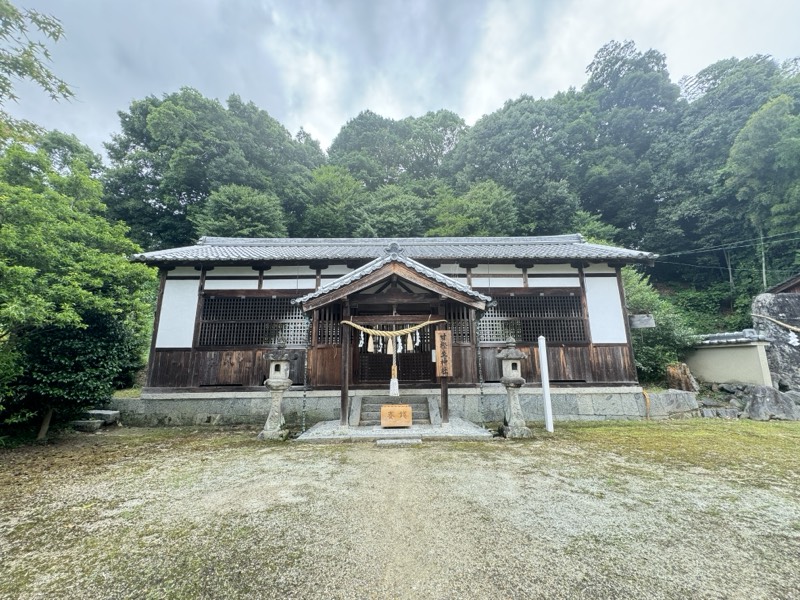
甘樫坐神社
An ancient shrine at the foot of Amakashi Hill, where the kukatachi trial-by-hot-water ritual is handed down.
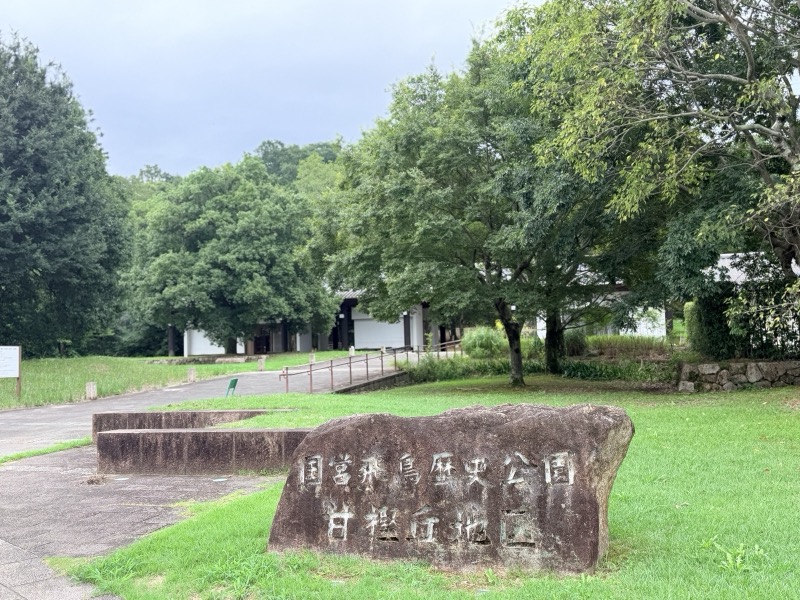
甘樫丘
A hill with views over all of Asuka, said to have been the site of the Soga clan's residences.
RELATED COLUMN
 The day Empress Kōgyoku prayed at the river's head: the rain rituals of 642Three kinds of rain-making were tried in turn, and when at last the empress prayed upstream on the Asuka…
 Is Amakashi Hill Really Today's Amakashi Hill?The Nihon Shoki says Soga no Emishi and Soga no Iruka had their mansions here. Yet excavation has found…
 "Ōe" Is Not a Name: Naka-no-Ōe, Furuhito-no-Ōe and Yamashiro-no-ŌeThe "Ōe" in Prince Naka-no-Ōe is not a personal name. It is a term showing eligibility to succeed to the…