
Published
In the mountains west of Tanzan Shrine is the grave of a monk said to have been buried sitting upright. There is a theory that this area is the site of Futatsuki-no-miya. When, and how, did that theory come about?

Tōnomine is the range of hills rising east of Asuka Village. Near Goharetsuyama at the summit (about 619 metres) is a mound said to be the grave of Fujiwara no Kamatari, and Tanzan Shrine, which enshrines Kamatari, was a temple called Myōraku-ji until the early Meiji period. The whole mountain was a place of worship where temple and shrine were one.
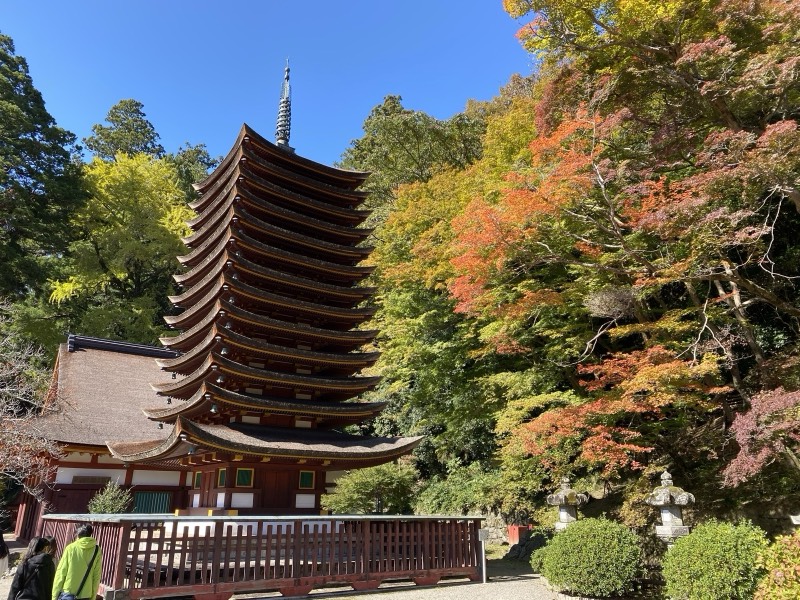
It is said that Kamatari's eldest son, Jōe, moved his father's remains here from Settsu and built the thirteen-storey pagoda. The temple grew into a great power, belonged to the Tendai school like Mt. Hiei, and clashed again and again with Kōfuku-ji in Nara. With the separation of Shinto and Buddhism in the Meiji period the temple was abolished, and only the shrine remained.
The Nihon Shoki records that in 656 Empress Saimei built Futatsuki-no-miya on the summit of this mountain. Where it stood is unknown. One candidate is Nezuki, west of Tanzan Shrine.
The monk said to rest at Nezuki is Zōga (917–1003). A Tendai monk who studied under Ryōgen on Mt. Hiei, Zōga disliked fame and was known for eccentric behaviour. In 963 Zōga moved to Tōnomine and kept up religious practice on this mountain until death, lecturing on the Lotus Sutra, performing the Lotus Samadhi four times a year, and leaving stories behind in collections such as the Konjaku Monogatarishū and the Uji Shūi Monogatari.
It is said that when Zōga died in 1003, at 87, it was while seated in meditation, and that the body was buried in that same posture.
The grave lies about one kilometre up a mountain path from the site of the west gate of Tanzan Shrine. It is said that the characters for Nezuki, meaning "the hollow of chanting", were chosen because this is the mountain where Zōga died in the midst of chanting the nembutsu.
Until the early Meiji period this was the site of Shigai-ji, known as the inner sanctuary of Tōnomine, with halls, a bell tower and monks' quarters. Today only stone walls and steps remain. At the very top of a flight of about 150 steps is a round mound about four metres across, built of stone in two tiers, which is said to be Zōga's grave. The landings on the way up are lined with a great many gravestones and stone Buddhas.
An Edo-period illustrated guide to famous places shows a five-ring stone pagoda carved "Namu Zōga Shōnin" standing on the mound. Only its lowest stone survives today, carved with the years 1602 and 1003. The mound is two tiers of round stonework on a double square stone platform, about two metres high: quite an elaborate grave for a monk in the mountains.
There is a theory that this Nezuki is the site of Futatsuki-no-miya.
The clue is the name. "Nezuki" has also been written with characters meaning "root zelkova", and through the character for zelkova (tsuki) it has been linked with Futatsuki-no-miya. The level ground near the top and the stone walls and steps around the hill also suggest the remains of a palace.
Even the local tourist association's guide says, however, that this "goes no further than speculation". The walls and steps are most naturally explained as belonging to Shigai-ji or to the Nezuki fort built on this ridge in the Middle Ages. In medieval times Tōnomine fought repeatedly with Kōfuku-ji and others, and a chain of forts ran along the ridges. No 7th-century remains have been found by excavation.
Besides, if this were Futatsuki-no-miya, it would not quite match the entry's "on the summit" of Tamu-no-mine, since Nezuki is not at the top of Tōnomine but on a ridge some way down to the west.
No ancient record places Futatsuki-no-miya at Nezuki. Some researchers think the link spread through gazetteers and local traditions from the Edo period on. Once something is written in an authoritative book, later books copy it, and before long it looks like the accepted view. This happens often with the origins of place names.
Two questions overlap here: where Futatsuki-no-miya stood in the 7th century, and when and why the tradition of Futatsuki-no-miya became attached to Nezuki. Answering the second does not answer the first. The two need to be considered separately.

To reach Nezuki, take the mountain path west from Tanzan Shrine. Gravestones and stone Buddhas line the steps on and on, more than you would expect in the mountains. Whether or not this was Futatsuki-no-miya, climbing the steps is enough to show that the mountain has been a place of prayer for a thousand years, since the Heian period. The footing is poor and the path is quiet; go dressed for hiking and allow plenty of time.
RELATED SPOT
RELATED COLUMN
 Jōe: Home After Twelve Years of Study in China, Dead the Same YearThe eldest son of Fujiwara no Kamatari crossed to Tang China at the age of eleven. He came back in the autumn…
 Mononobe no Moriya: The Teibi Rebellion, Read from the Losing SideIn 587, Mononobe no Moriya was attacked by Soga no Umako's army and killed at his home base in Kawachi. He is…
 Whose Successor Was Empress Jitō? Tenmu's Empress, and Tenchi's DaughterAs the empress who completed the ritsuryō state (a state governed by law codes), she is usually spoken of in…