
Published
In 587, Mononobe no Moriya was attacked by Soga no Umako's army and killed at his home base in Kawachi. He is known as the man who threw away the Buddha. Yet every record of him was written by the winning side. Here we reread that record from Moriya's side.
In the autumn of 587, Mononobe no Moriya was killed at his own house in Shibukawa, in Kawachi Province. That year was a hinoto-hitsuji year (丁未, teibi) in the sixty-year cycle, so the fighting later came to be called the Teibi Rebellion.
Moriya is remembered as the man who opposed Buddhism and threw a Buddhist statue into a canal. Almost everything we know of him comes from the Nihon Shoki (Chronicles of Japan).
The Nihon Shoki was completed in 720, more than 130 years after the battle, by a court descended from the winning side. No record survives in Moriya's own words. Even so, read closely, the chronicle lets slip here and there what Moriya said and what he feared.
The Mononobe were a powerful clan serving the Great King, thought to have been in charge of military affairs, punishment and the worship of the gods. Moriya was head of the clan and held the rank of Ōmuraji, the highest rank at court alongside Soga no Umako, who held the rank of Ōomi.
The Nihon Shoki also calls him Mononobe no Yuge no Moriya; Yuge is thought to be the name of his mother's clan. The family's base was in Kawachi, the area that today runs from Yao to Higashi-Osaka in Osaka Prefecture.
The quarrel over Buddhism went back a generation. When a Buddhist statue arrived from Baekje in 552, it was Umako's father, Soga no Iname, who asked to accept it, and Moriya's father, Mononobe no Okoshi, who opposed it.
In 585 an epidemic broke out. Together with Nakatomi no Katsumi, Moriya told the emperor that it was the Soga's worship of a foreign god that had caused it, and he was given permission to act.
Moriya went to the temple, had the pagoda pulled down and set on fire, and had the statue that survived the flames thrown into the Horie canal at Naniwa. The three nuns whom Umako had ordained were stripped of their robes and flogged at Tsubaichi.
But the epidemic did not end. The Nihon Shoki says that the emperor and Moriya himself fell ill with sores, and that the dead filled the land. People whispered, it adds, that this was punishment for burning the Buddha.
From Moriya's side, he had acted to protect the gods of the land. Yet the chronicle tells the story as if what followed were retribution.
That autumn Emperor Bidatsu died. At the mogari no miya, the temporary palace where his body lay before burial, the ministers came forward one by one to deliver eulogies.
When Umako stepped up wearing a long sword, Moriya laughed and said he looked like a sparrow pierced by a hunting arrow. It is usually read as a jibe that the long sword looked out of place on the small-framed Umako.
Then, when Moriya delivered his eulogy with his hands and feet trembling, it was Umako's turn to laugh: "Someone should hang bells on him." From this, says the Nihon Shoki, a quiet grudge grew between the two men.
What is shown here is not only a difference of belief about Buddhism, but personal enmity between two men.
The next emperor was Bidatsu's younger brother, Emperor Yōmei. Another brother, Prince Anahobe, resented this.
In 586, Prince Anahobe tried to force his way into the mourning palace where Bidatsu's widow, Kashikiya-hime (later Empress Suiko), was staying, and the gates were shut against him by Miwa no Sakau, a trusted retainer of the late emperor. The angry prince ordered Sakau killed, and it was Moriya who killed him and his sons.
Hearing of this, Umako lamented that the realm would soon fall into disorder. Moriya, according to the Nihon Shoki, replied that this was no business of a petty official like him. Moriya had placed his bet on Prince Anahobe.
In the fourth month of 587, Emperor Yōmei fell ill and asked his ministers whether he should take refuge in the Buddha's teaching. Moriya and Katsumi objected: why turn against the gods of our own land to revere a foreign god? Umako answered that the emperor's wish should be followed.
When Prince Anahobe entered the palace bringing a monk with him, Moriya glared at him in fury, the chronicle says. Then a man named Oshisakabe no Kekuso came to him in secret with a warning: the ministers were plotting against him and meant to cut off his road home.
Moriya left the palace, withdrew to his estate at Ato in Kawachi, and gathered men. He then sent messengers to Umako with this message: he had heard that the ministers planned to kill him, and that was why he had withdrawn.
He withdrew not to attack but to protect himself. It is one of the few arguments of Moriya's own that the Nihon Shoki preserves.
His ally Katsumi made images of the princes and cursed them, then, seeing which way things were going, tried to change sides to Prince Oshisaka no Hikohito no Ōe. On his way back he was cut down by Tomi no Ichii. Emperor Yōmei died soon afterwards.
Moriya tried to put Prince Anahobe on the throne. The plan, the Nihon Shoki says, was to make their move under cover of a hunting trip. But the plot leaked.
In the sixth month, Umako, claiming an order from Kashikiya-hime, had Prince Anahobe killed, and the next day Prince Yakabe, who had been close to him, as well. Moriya had lost the prince he meant to crown.
What comes into view here is less a struggle over whether to worship the Buddha than a struggle over who would be the next emperor. The religious conflict lay on top of that.
In the seventh month, Umako gathered the princes and ministers and raised an army against Moriya. Prince Hatsusebe (later Emperor Sushun), Prince Takeda and Prince Umayado (Prince Shōtoku) joined it, while a second force marched from Shiki District on the house at Shibukawa.
Moriya led his kin and the men who served him and met them behind an inaki, a fort built of stacked rice sheaves. He himself climbed a hackberry tree at Kinusuri and shot arrows down on the attackers like rain.
His force was strong; the attackers fell back three times, the Nihon Shoki says. It is worth noticing that the winners' own record admits Moriya's strength so plainly.
At this point Prince Umayado carved images of the Four Heavenly Kings from nurude wood and vowed to build a temple and pagoda if they gave him victory, and Umako too vowed to build a temple and spread the Buddha's teaching. Then Tomi no Ichii shot Moriya down from the tree, and Moriya and his sons were killed. His army scattered; some, the chronicle says, changed their names and hid in the reed beds.
Some scholars suggest that the scene of Prince Umayado's vow grew up later, within the cult of Prince Shōtoku.
The Nihon Shoki also records the end of Totoribe no Yorozu, who served Moriya.
Yorozu had been guarding Moriya's residence at Naniwa. Hearing that his master was dead, he fled into the mountains of Izumi, where pursuers surrounded him. He cried out that he had served as a shield of the Great King, so why was he being hunted down without even being asked why? After shooting down more than thirty men, he took his own life.
Orders were given to cut his body into eight pieces and display them in eight provinces. Then, the story goes, the white dog Yorozu had kept carried its master's head to an old burial mound, laid it there, and stayed beside it until it starved to death. Moved by this, the court allowed Yorozu's kin to bury both him and the dog.
There are few scenes in the Nihon Shoki written with this much feeling about someone on the losing side.
After the rebellion, half of the servants of Moriya's house and his residence were given to Shitennō-ji, the temple to be built in Settsu. Tomi no Ichii, who had shot Moriya, was granted rice fields.
The Nihon Shoki contains one more striking line. People at the time, it says, gossiped that Umako's wife was Moriya's younger sister, and that Umako had killed Moriya by following her scheme. The two enemies were also brothers-in-law.
Nor did the Mononobe end here. The family line survived, and in the Jinshin War of 672, eighty-five years later, there were Mononobe men on both sides.
On the side of Prince Ōama (later Emperor Tenmu) was his attendant Enoi no Okimi, also called Mononobe no Okimi. It was he who told the prince that the Ōmi court was gathering men and giving them weapons, which set the uprising in motion. He followed the prince east, and when he died Emperor Tenmu granted him the rank of Naidaishi and made him head of the Mononobe clan.
On the side of Prince Ōtomo was Mononobe no Muraji no Maro. The Nihon Shoki records him as one of the few who stayed with the defeated prince to the very end. Even so, Maro was later employed by Emperor Tenmu, took the clan name Isonokami, and in the early eighth century rose as high as Minister of the Left: Isonokami no Maro.
So the family that lost the rank of Ōmuraji in Moriya's day had men on both the winning and the losing side, and both of them were later held in high regard at court.
The Nihon Shoki builds its story on a simple scheme: the Soga who welcomed the Buddha against the Mononobe who rejected him. But as we have seen, at the center of the conflict lay the succession to the throne, and the question of whether the Ōomi or the Ōmuraji would run the court.
In the Shibukawa area of Yao, Moriya's home ground, the remains of a seventh-century temple, the Shibukawa Haiji, have been found. Some see it as a temple connected with the Mononobe; others note that it was built after Moriya's fall and that its founder is unknown. Did the whole Mononobe clan reject the Buddha, or did one Ōmuraji named Moriya act that way because of his position? There is no answer yet.

In 588, the year after the battle, Umako began building a temple at Makami-no-hara in Asuka. Monks, temple carpenters and roof-tile makers were invited from Baekje, and it was completed in 596. This was Hōkō-ji, later called Asuka-dera, regarded as the first full-scale Buddhist temple in Japan.
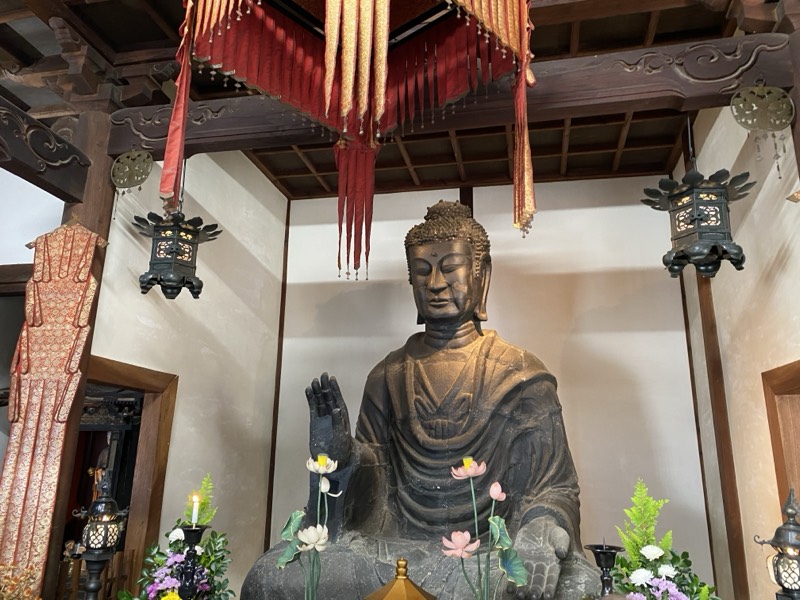 SPOTAsuka-dera Temple and the Head Mound of Soga no Iruka飛鳥寺・蘇我入鹿首塚Japan's first full-scale Buddhist temple. The Great Buddha of Asuka still sits on the spot where it was made, 1,400 years ago.Access: Right by the "Asuka Daibutsu-mae" stop on the Asuka loop bus from Kintetsu Kashiharajingu-mae StationSee the spot page →
A mound said to be Moriya's grave still stands in Yao, next to Taisei Shōgun-ji, a temple said to have been founded by Prince Shōtoku to commemorate the victory.
The winners' temple was built in Asuka; the loser's grave remained in Kawachi. When you stand before the Great Buddha of Asuka-dera, try to remember that this temple rose after one family was destroyed.
Walk south from Asuka-dera and you come to the Ishibutai Kofun, widely thought to be Umako's tomb. The man who defeated Moriya, then, lies here in Asuka.
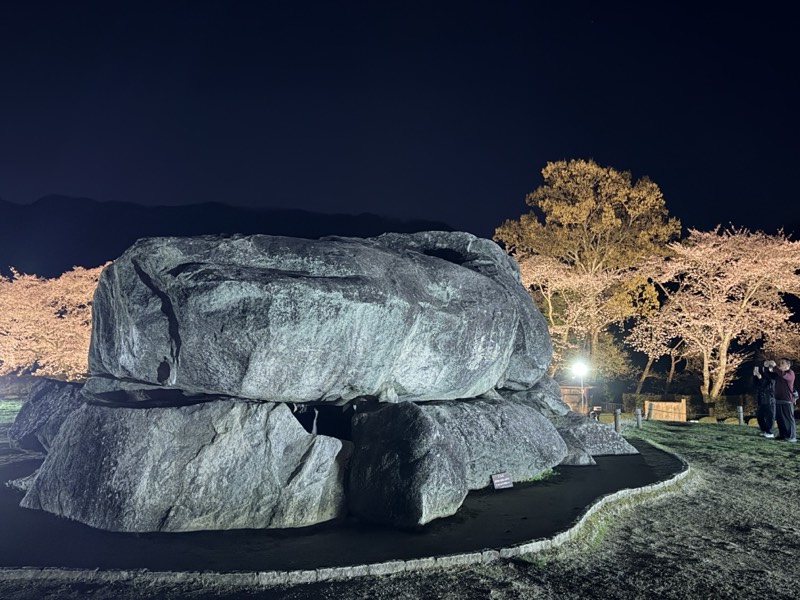 SPOTIshibutai Kofun石舞台古墳One of the largest stone burial chambers in Japan, its giant boulders left bare to the sky. The image most people picture when they think of Asuka.Access: Short walk from the "Ishibutai" stop on the Asuka loop bus from Kintetsu Kashiharajingu-mae StationSee the spot page →
RELATED SPOT
飛鳥寺・蘇我入鹿首塚
Japan's first full-scale Buddhist temple. The Great Buddha of Asuka still sits on the spot where it was made, 1,400 years ago.
石舞台古墳
One of the largest stone burial chambers in Japan, its giant boulders left bare to the sky. The image most people picture when they think of Asuka.
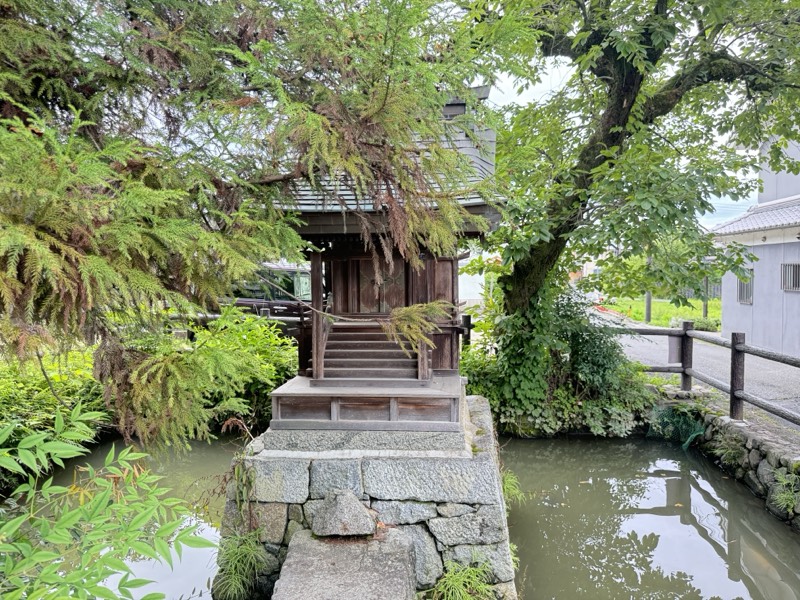
向原寺(豊浦寺跡)
A temple standing on the site of Toyura-dera, Japan's first nunnery, with the Naniwa Pond tied to the legend of Buddhism's arrival.
RELATED COLUMN
Was Prince Shōtoku Really Soga no Umako? Reading the "Prince = Umako" TheoryAlmost every achievement of Prince Shōtoku comes with the name of Soga no Umako beside it. What if the man…Where Was the Naniwa Canal? A Discarded Buddha's Road to Zenkō-jiA waterway in Osaka near the sea, or a small pond in Asuka? The "Naniwa no Horie", which the Nihon Shoki…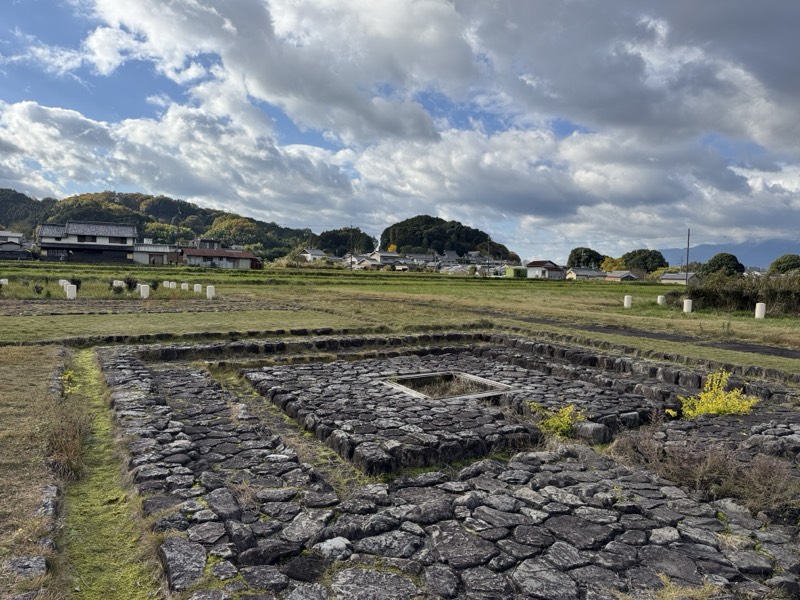 Prince Yamashiro no Ōe: Why Was Prince Shōtoku's Son Destroyed?In 643, Prince Yamashiro no Ōe, son of Prince Shōtoku, was hunted down by Soga no Iruka's soldiers and took…