
Published
In 643, Prince Yamashiro no Ōe, son of Prince Shōtoku, was hunted down by Soga no Iruka's soldiers and took his own life with his family at Ikaruga. His mother was a daughter of Soga no Umako. Why was a prince of Soga blood destroyed by the Soga? We consider the throne, the power of the Jōgū house, the involvement of people other than Iruka, and the way the Nihon Shoki tells the story.

In the eleventh month of 643, at the temple in Ikaruga, Prince Yamashiro no Ōe took his own life together with his consorts, children and brothers. He had been hunted down by soldiers sent by Soga no Iruka.
Prince Yamashiro was the son of Prince Umayado, Prince Shōtoku. The prince's family is called the Jōgū royal house, and on this day its line came to an end.
Why did Prince Shōtoku's son have to be destroyed? After following the account in the Nihon Shoki, we set out several ways of looking at it.
The first thing to grasp is that Prince Yamashiro was no outsider to the Soga. His mother was Tojiko no Iratsume, a daughter of Soga no Umako. Yamashiro was Umako's grandson, and Emishi was his mother's brother, his uncle.
And Prince Furuhito no Ōe, whom Iruka backed for the throne, also had a daughter of Umako for his mother, Hotehi no Iratsume. In terms of Soga blood, the two were the same. Even so, the main Soga house backed one and destroyed the other.
The story goes back fifteen years. In the third month of 628, on her deathbed, Empress Suiko called two princes separately: Prince Tamura, grandson of Emperor Bidatsu, and Prince Yamashiro.
To Prince Tamura she said that ruling the realm was a heavy charge, and he should be careful and not speak of it lightly. To Prince Yamashiro she said that he was still immature, and that even if he had wishes he should not stir things up, but wait for the ministers' word and follow it.
Words that could be read either way. A will that named no successor became the seed of conflict.
The Ōomi, Soga no Emishi, gathered the ministers at his house to discuss the next emperor. Opinion divided. Ōtomo no Kujira and others backed Prince Tamura on the strength of the will; Kose no Ōmaro and others backed Prince Yamashiro.
Prince Yamashiro sent messengers to his uncle Emishi, arguing that the will had marked him as successor. But Emishi moved toward putting Prince Tamura on the throne.
The one who backed Prince Yamashiro to the end was Sakaibe no Marise, Umako's younger brother and so Emishi's uncle, an elder of the Soga clan. Marise refused to obey Emishi and took refuge in the palace of Yamashiro's younger brother, Prince Hatsuse. But Prince Hatsuse died suddenly, and Marise was attacked by Emishi's soldiers and killed.
In 629 Prince Tamura took the throne as Emperor Jomei. The Soga elder who had supported Yamashiro had been eliminated by the main Soga house itself.
When Emperor Jomei died in 641, his empress, Princess Takara, took the throne the next year as Empress Kōgyoku. Once again, Prince Yamashiro did not.
One view holds that female sovereigns were enthroned as a bridge until the next emperor was settled. If so, the question of who would follow Empress Kōgyoku was already being asked. At this time there were three men called ōe, those regarded as eligible for the throne: Yamashiro, Furuhito, and Naka no Ōe, son of Jomei and Kōgyoku.
In 642 Emishi had two tombs built for himself and Iruka while they were still alive, the "twin tombs of Imaki." For the work he even conscripted people who belonged to the Jōgū royal house.
This angered the Jōgū Ōiratsume, thought to be Yamashiro's consort. The Soga, she said, do as they please with the government of the realm and commit many discourtesies. There are not two suns in heaven, nor two kings in a land. By what right do they use the Jōgū house's people? So the Nihon Shoki records her lament. The rift between the Jōgū house and the main Soga house could no longer be hidden.
Where these twin tombs were is unknown. Some propose the Koyamada Kofun in Asuka Village or the Shōbuike Kofun in Kashihara as candidates.
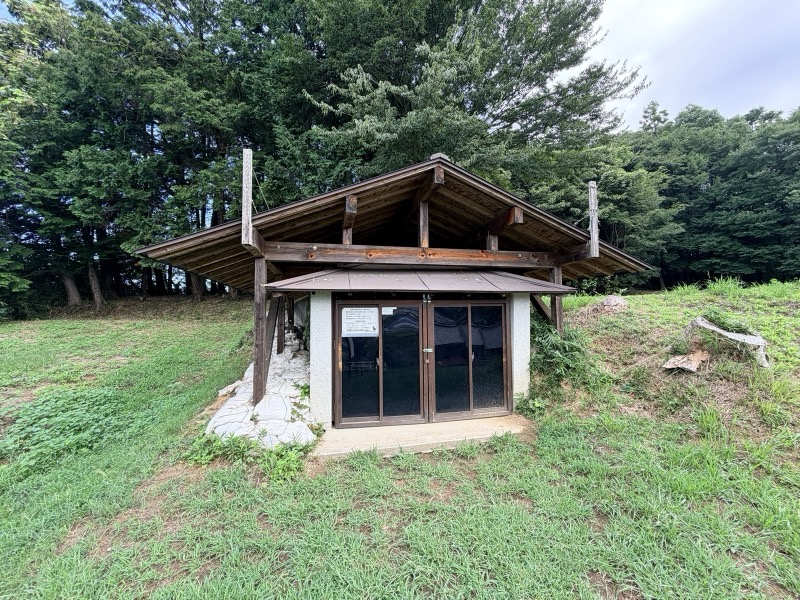 SPOTShōbuike Kofun菖蒲池古墳A square mound about 30 m on each side, with two house-shaped sarcophagi side by side. The stone chamber is inside a protective shelter.Access: About 15 minutes on foot from Kintetsu Okadera StationSee the spot page →
In the tenth month of 643, Emishi secretly gave Iruka the purple cap of the Ōomi, treating him as if he held that office. The Nihon Shoki goes on to say that Iruka plotted to set aside the Jōgū princes and make Prince Furuhito emperor.
The next month, Iruka gave troops to Kose no Tokoda and Haji no Saba and had them attack the Ikaruga Palace. Yamashiro's attendants held them off and shot Haji no Saba dead, and in the confusion Yamashiro threw horse bones into his sleeping hall so that he would seem to have died in the fire, and fled with his family to Mount Ikoma.
In the mountains, his follower Miwa no Fumiya urged him: go east, gather the Jōgū house's people there, raise an army and come back to fight, and victory is certain.
The Nihon Shoki gives Yamashiro's answer like this. If we do as you say, we will surely win. But I have resolved not to burden the people with labor for ten years. How could I trouble so many for my own sake? I do not want people in later ages to say they lost their fathers and mothers because of me. Is it only by winning in battle that one is a man of valor? To give up one's life and make the realm secure is also valor.
Yamashiro returned to the Ikaruga temple, told the surrounding soldiers that he gave his body to Iruka, and took his life with his family. The Nihon Shoki adds that banners and canopies of five colors appeared in the sky above the temple and music sounded, but when Iruka looked up they turned into black clouds.
When Emishi heard the news, he is said to have rebuked Iruka: Alas, how foolish Iruka is, and what an evil deed he has done. Your own life is in danger now.
From here on, this is interpretation. There are several views on why Prince Yamashiro was destroyed, and no single one explains it completely.
The simplest view is that this was a succession struggle. Iruka wanted Furuhito to be emperor, and Yamashiro, son of the great prince, older, called ōe, and supported by some ministers, was the biggest obstacle.
If the strength of Soga blood was the same, what made the difference? Furuhito was the son of an emperor, Jomei, while Yamashiro's father, Prince Umayado, had never reigned. And the young Furuhito had no one to rely on but the main Soga house, while Yamashiro was a grown man with a household of his own. For the main Soga house, Furuhito was clearly the easier one to manage.
The second view is that the Jōgū house itself held great power. Since the great prince's day it had kept a palace and temple at Ikaruga and held people in many regions who supported it. When Miwa no Fumiya said they could win by raising troops in the east, it was presumably because the house had that many people there.
When Ōiratsume said over the twin tombs that "there are not two kings in a land," she meant that the main Soga house was behaving like a king. But from the Soga side, it may have looked as if there were a second royal house at Ikaruga.
The Nihon Shoki says Iruka sent troops on his own, and that even his father Emishi rebuked him. But other records give a somewhat different picture.
The Kaden, a biography of the Fujiwara family, says Iruka plotted together with princes. The Jōgū Shōtoku Taishi Den Hoketsuki, compiled in the Heian period, names Prince Karu, later Emperor Kōtoku, among the attackers. Kose no Tokoda, who led the attack, later became Minister of the Left under Emperor Kōtoku.
If these are right, Iruka was not the only one who wanted the Jōgū house gone. For royals with an eye on the throne, and the clans around them, the great prince's son was in the way too. Iruka may simply have stood at the head of those shared interests.
Lastly, there is the nature of the record itself. The Nihon Shoki was compiled within the line of those who struck down Iruka two years later in the Isshi Incident. The more villainous Iruka appears, the more righteous the Isshi Incident becomes.
Yamashiro's words choosing death over war for the people's sake, and the five-colored banners above the temple, are hard to take as plain fact. Some scholars think that as the cult revering the great prince as a saint grew, his son's end too was shaped into the image of a saint giving up his life. And the Nihon Shoki says nothing at all about whether Prince Karu, who later became emperor, took part.
In the sixth month of 645, Iruka was cut down at the Asuka Itabuki Palace by Prince Naka no Ōe and Nakatomi no Kamatari, and the next day Emishi took his own life at his house on Amakashi Hill. Prince Furuhito, having lost his backers, became a monk and went to Yoshino, but within the same year he was accused of plotting rebellion and killed.
The next to take the throne was Prince Karu, as Emperor Kōtoku. Yamashiro, Iruka, Furuhito: within just two years, two of the three men called ōe, and the house of the Ōomi that stood between them, had vanished. The one left standing at the end was Naka no Ōe.
Ikaruga, where Yamashiro met his end, is the area around Hōryū-ji, about twenty kilometers northwest of Asuka. The traces of the other protagonists, however, remain in Asuka: the Asuka Palace Site where Iruka was killed, Amakashi Hill where Emishi and Iruka had their houses, and Iruka's head mound west of Asuka-dera.
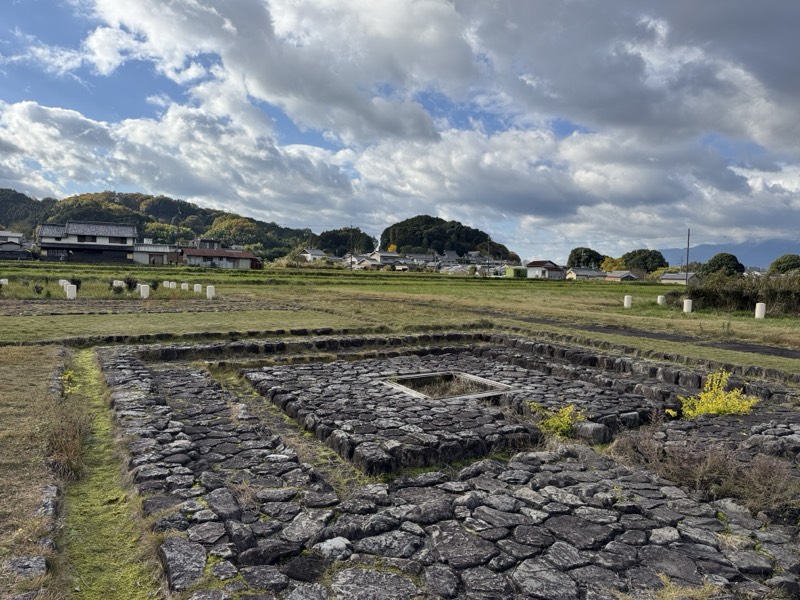 SPOTAsuka Palace Site (traditionally the Asuka Itabuki Palace Site)飛鳥宮跡(伝 飛鳥板蓋宮跡)The political heart of Asuka, where several palaces were built one on top of another.Access: About 5 minutes on foot from the "Oka-hashimoto" stop on the Asuka loop bus from Kintetsu Kashiharajingu-mae StationSee the spot page →
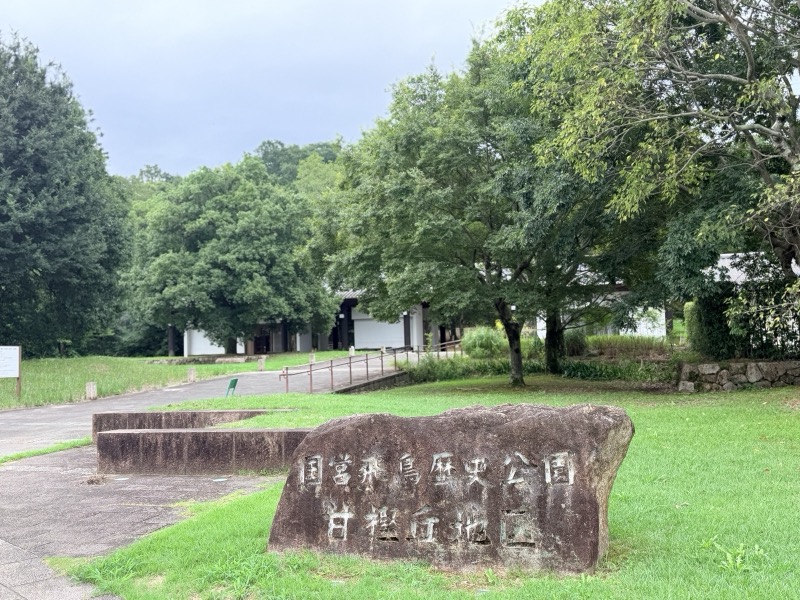 SPOTAmakashi Hill甘樫丘A hill with views over all of Asuka, said to have been the site of the Soga clan's residences.Access: Right by the "Amakashi-no-oka" stop on the Asuka loop bus from Kintetsu Kashiharajingu-mae StationSee the spot page →
RELATED SPOT
飛鳥宮跡(伝 飛鳥板蓋宮跡)
The political heart of Asuka, where several palaces were built one on top of another.
甘樫丘
A hill with views over all of Asuka, said to have been the site of the Soga clan's residences.
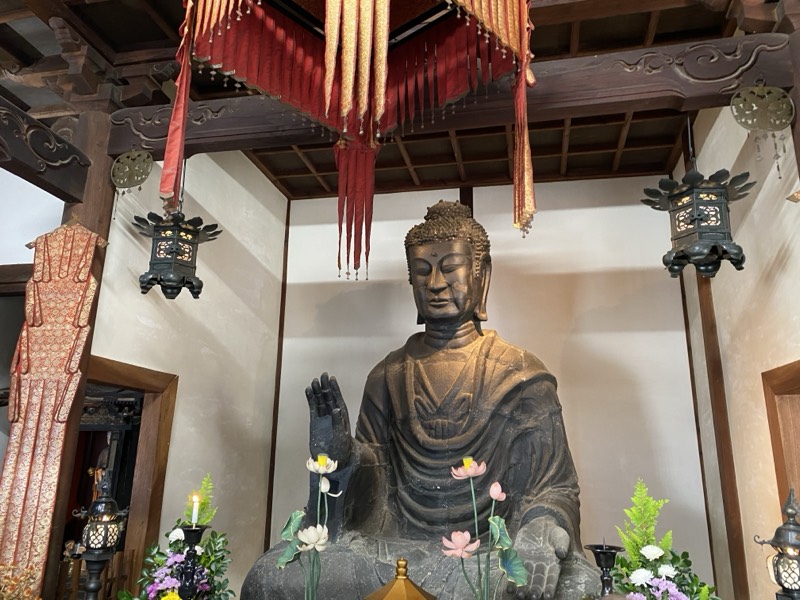
飛鳥寺・蘇我入鹿首塚
Japan's first full-scale Buddhist temple. The Great Buddha of Asuka still sits on the spot where it was made, 1,400 years ago.
菖蒲池古墳
A square mound about 30 m on each side, with two house-shaped sarcophagi side by side. The stone chamber is inside a protective shelter.
RELATED COLUMN
 "Ōe" Is Not a Name: Naka-no-Ōe, Furuhito-no-Ōe and Yamashiro-no-ŌeThe "Ōe" in Prince Naka-no-Ōe is not a personal name. It is a term showing eligibility to succeed to the…Mononobe no Moriya: The Teibi Rebellion, Read from the Losing SideIn 587, Mononobe no Moriya was attacked by Soga no Umako's army and killed at his home base in Kawachi. He is…
 Prince Anahobe: A Prince Who Grasped Too Hard, or an Eliminated Candidate?He declared at a mourning palace that one should serve the living king, forced himself on the late emperor's…