


1 / 3
談山神社(たんざんじんじゃ)
A mountain shrine said to be where the plot behind the Taika Reforms was hatched. Its wooden thirteen-storey pagoda is the only one in the world.
The shrine stands in the folds of Tōnomine, the mountain east of Asuka Village. It is dedicated to Fujiwara no Kamatari.
Its name comes from a conversation held on this mountain. Prince Naka no Ōe and Nakatomi no Kamatari are said to have discussed here how to strike down Soga no Iruka. The mountain came to be called Katarai-yama, "the mountain of the talks," which later gave Tanzan-jinja its name, or so the story goes.
The Isshi Incident of 645 took place at the palace in Asuka, but the planning, by this account, happened here. If you climb the mountain path behind the main hall, you will find a stone monument inscribed "Tanzan."
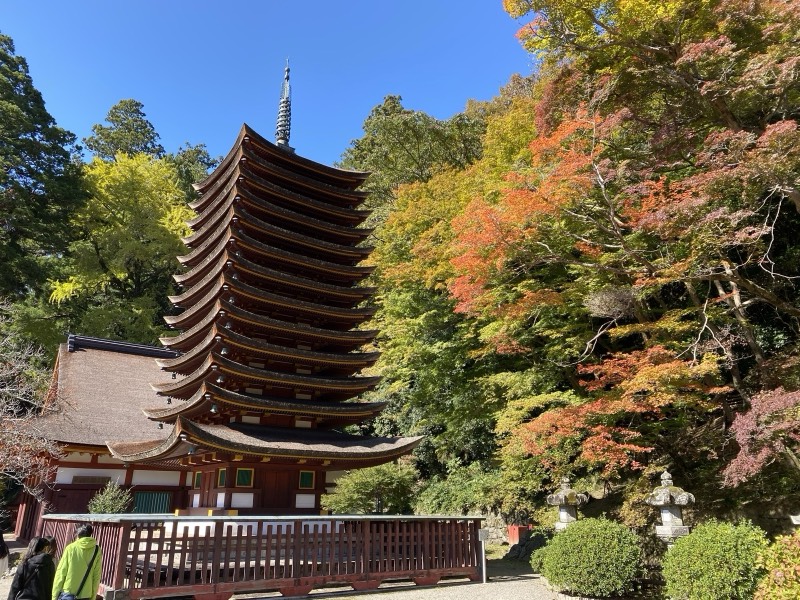
The first thing to catch your eye in the grounds is the thirteen-storey pagoda. Its thirteen roofs stack up slender and tall in a form you will not see anywhere else. It is the only surviving wooden thirteen-storey pagoda in the world.
It stands about 17 m high. The present building is a reconstruction of 1532, roofed with cypress bark. In autumn the surrounding maples turn colour, and the vermilion pagoda is framed by red leaves.
According to tradition, the pagoda was built over Kamatari's grave after his remains were moved from Settsu to Tōnomine, and it was erected by Kamatari's eldest son, Jōe. However, this account does not fit with the year of Jōe's death.
The worship hall was built in 1520. It is in the kakezukuri style, with its floor projecting out over the mountainside on long pillars; looking up from below, the pillars stand like a forest.
Rows of hanging lanterns line the eaves. From the gallery you can see the Tōnomine hills through the lanterns. There are few walls separating inside from outside, so when you sit on the floor the mountain is right in front of you.
The main sanctuary was rebuilt in 1850. It is a richly coloured building in the Kasuga style, three bays wide, and it is said that Nikkō Tōshōgū took this shrine as its model.
Until the beginning of the Meiji era (1868–1912), this was a Buddhist temple called Myōraku-ji, also known as Tōnomine Myōraku-ji or Tōnomine-dera. The Shōryō-in hall honouring Kamatari, the pagoda and the temple halls all stood on one mountain, and gods and buddhas were not kept apart.
With the separation of Shinto and Buddhism in the Meiji era the temple was abolished and became Tanzan-jinja. Many of the buildings you now see as shrine buildings were originally temple halls. The building called the Jinbyō Haisho was once the lecture hall.
Below the worship hall is a level area called the kemari ground. It recalls the story in the Nihon Shoki (Japan's oldest official chronicle, compiled in 720) that Prince Naka no Ōe and Kamatari first met at a game of kemari, a courtly kick-ball game.
Every year on 29 April and 3 November the Kemari Festival is held, and players in court costume kick the ball.
The shrine is outside Asuka Village, in Tōnomine, Sakurai City. It is about 20 minutes by car from Ishibutai Kofun. By public transport, take the bus bound for Tanzan-jinja from Kintetsu/JR Sakurai Station (about 25 minutes); the shrine is about 3 minutes on foot from the last stop.
Stone steps lead from the entrance to the main sanctuary. Being on a mountain, it is several degrees cooler than the villages below.
The shrine is famous for its autumn leaves, and the grounds get crowded from mid- to late November. Early in the morning you can walk the lantern-lined galleries in peace.
Published
READ MORE
 Whose Successor Was Empress Jitō? Tenmu's Empress, and Tenchi's DaughterAs the empress who completed the ritsuryō state (a state governed by law codes), she is usually spoken of in…
 Jōe: Home After Twelve Years of Study in China, Dead the Same YearThe eldest son of Fujiwara no Kamatari crossed to Tang China at the age of eleven. He came back in the autumn…
 The Ones Who Came Back Across the Sea: What the Overseas Students Brought HomeTo Sui China, then to Tang. Some spent decades across the sea before coming home. What they brought back was…
NEARBY
岡寺(龍蓋寺)
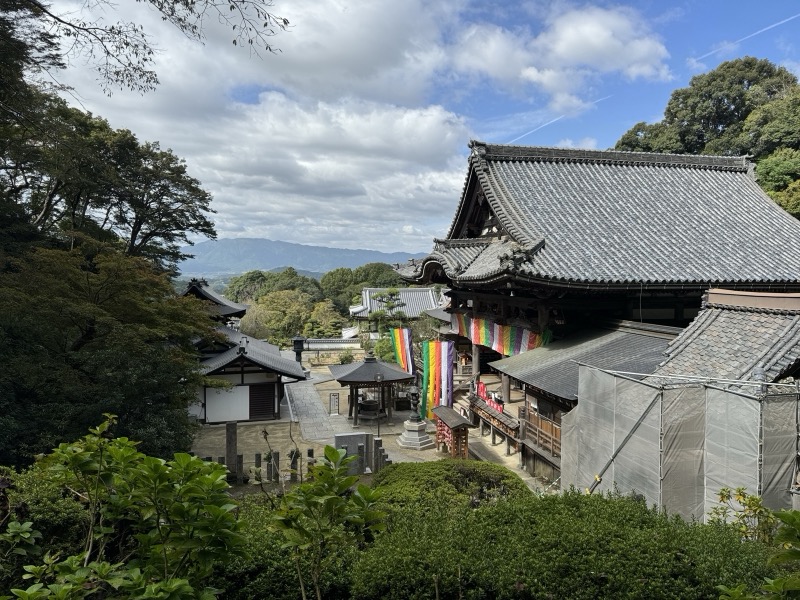
Japan's first temple for warding off misfortune, home to a huge clay statue of Nyoirin Kannon.
飛鳥川上坐宇須多伎比売命神社
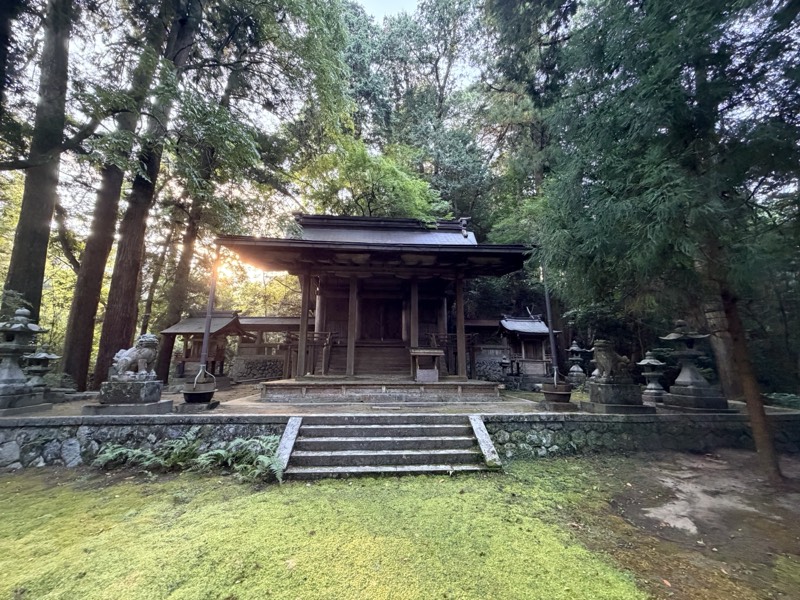
An ancient listed shrine in a cedar grove, guarding the upper reaches of the Asuka River.
山田寺跡
A temple site where a corridor was excavated just as it had collapsed and been buried.