Published
Nukata no Ōkimi had a daughter with Prince Ōama and is thought to have later gone over to Emperor Tenchi. In the poems the two exchanged at Gamōno, did her lingering feelings for Ōama show through? Here is the theory that reads them that way.

Nukata no Ōkimi is one of the leading Man'yōshū (Japan's oldest anthology of poetry) poets of the Asuka period. Several poems she composed on public occasions survive in the anthology, beginning with the "Nikitatsu ni" poem composed when Empress Saimei set sail.
The chapter on Emperor Tenmu in the Nihon Shoki (Japan's oldest official chronicle, compiled in 720) records that the emperor first took as wife Nukata no Ōkimi, daughter of Prince Kagami, and had by her Princess Tōchi. In her youth, Nukata no Ōkimi was the wife of Prince Ōama, later Emperor Tenmu.
On the other hand, the Man'yōshū contains a poem titled "Composed by Nukata no Ōkimi while longing for the Ōmi Emperor." The Ōmi Emperor means Emperor Tenchi, who moved the capital to the Ōtsu Palace in Ōmi: Ōama's elder brother.
Kimi matsu to / waga koioreba / waga yado no / sudare ugokashi / aki no kaze fuku
"As I wait for you, longing, the autumn wind blows, stirring the blinds of my house." On the strength of poems like this, it has long been thought that Nukata no Ōkimi later went over to Emperor Tenchi: a love-triangle story in which the elder brother took his younger brother's wife, or summoned her to his side. However, the Nihon Shoki has no such entry, and nothing is known for certain.
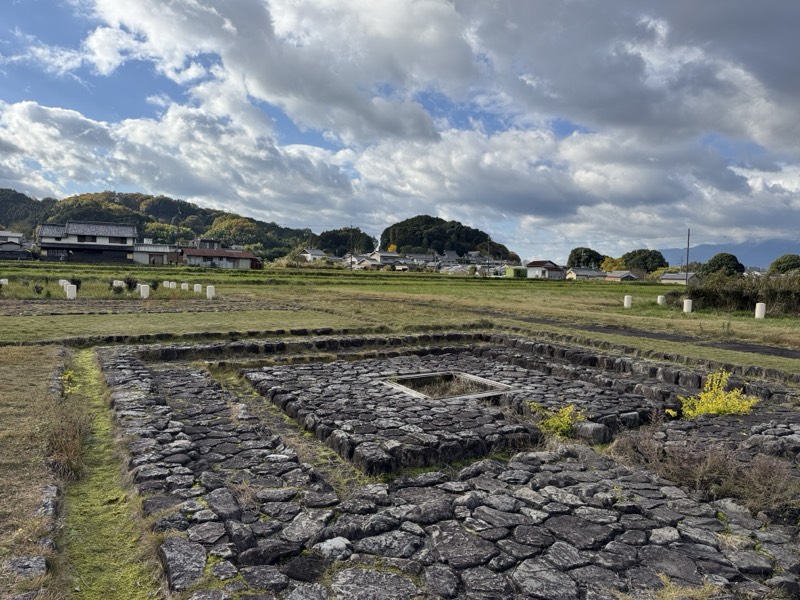
On the fifth day of the fifth month of 668, the emperor held a hunt at Gamōno in Ōmi (around present-day Higashiōmi City, Shiga Prefecture). It was a kusurigari, a "medicine hunt" to gather medicinal herbs and young deer antlers, and Prince Ōama, the other princes and senior courtiers attended.
Two poems from this occasion stand side by side in Book 1 of the Man'yōshū. First, Nukata no Ōkimi's:
Akanesasu / murasakino yuki / shimeno yuki / nomori wa mizu ya / kimi ga sode furu
"Going through the fields of murasaki (purple gromwell), through the forbidden royal fields, you wave your sleeve at me. Won't the field warden see?" Waving one's sleeve was also a gesture of love, meant to draw the other person's heart.
Prince Ōama replied:
Murasaki no / nioeru imo o / nikuku araba / hitozuma yue ni / ware koime ya mo
"If I hated you, my love, lovely as the purple gromwell, would I long for you so, knowing you are another man's wife?"
"Another man's wife" can be read as Nukata no Ōkimi, now with his elder brother Emperor Tenchi. Ōama waving his sleeve while wary of being seen, and Nukata no Ōkimi pretending to scold him but caring all the same: perhaps feelings lingered between them even after they parted. There is a theory that reads this exchange as poems of a secret love.
Nukata no Ōkimi's poem seems to reproach the man waving his sleeve, yet she does not take her eyes off him. Her worry, "won't the field warden see?", is something you would only say if the two of you could not afford to be seen together. This reading sees in it the heart of a Nukata no Ōkimi who, though now with Tenchi, still thought of Ōama.
Just four years later, when Emperor Tenchi died, Ōama raised an army, won the Jinshin War (672) and returned to Asuka to take the throne. Read with knowledge of what came after, the two Gamōno poems even seem to hint at tension between the brothers.
Among scholars, however, the prevailing view is that the two poems were light entertainment composed at a banquet.
One reason is how the Man'yōshū classifies them. Love poems are normally grouped as sōmon (poems of mutual exchange), but these two are among the zōka (miscellaneous poems), which collect poems for ceremonies, royal excursions and the like. The idea is that at the banquet after the hunt, the former husband and wife deliberately exchanged love poems in front of everyone to liven things up. It is also said that Nukata no Ōkimi was nearly 40 at the time, and that her daughter Princess Tōchi had already married Tenchi's son, Prince Ōtomo.
Even if it was entertainment, though, the subject chosen was the couple's former relationship. You could say the poems worked as entertainment precisely because everyone around them knew about it.
Nukata no Ōkimi lived on through Emperor Tenmu's reign into Empress Jitō's. In her later years she exchanged poems with Prince Yuge, a son of Tenmu, who was then in Yoshino.
Inishie ni / kouramu tori wa / hototogisu / kedashi ya nakishi / aga moeru goto
"The bird that cries out longing for the past must be the hototogisu (lesser cuckoo). Surely it cried, just as I long for those days." There is also a reading that takes the "past" Nukata no Ōkimi longs for here to be the days when Emperor Tenmu was alive.
Were the two Gamōno poems a secret love or a banquet game? There is no answer. But if you recall these poems while walking through Asuka, which became Tenmu's capital, the distance between those two people of 1,300 years ago may feel just a little shorter.
RELATED SPOT
RELATED COLUMN
 After the Oath: What Became of Emperor Tenmu's PrincesIn 679 Emperor Tenmu made six princes swear at Yoshino never to fight one another. It is well known that the…Prince Takechi: The Eldest Son Far from the Throne, Yet Called "Mikoto"The man given command of the army in the Jinshin War was a 19-year-old eldest son. Because of his mother's…
 Two Who Crossed Imo Pass: Prince Ōama Once, Empress Jitō 31 TimesEnter the mountains at the far end of Asuka, cross a single ridge, and you are in Yoshino. Prince Ōama…