
Home/Columns/Seven Banners Before the Gate on New Year's Morning: The Banner-Pole Remains at Fujiwara Palace
Published
On New Year's Day 701, seven banners stood before the gate of the Great Audience Hall at Fujiwara Palace: a crow standard, and banners of the sun, the moon and the Four Guardian Beasts. In 2016, this one sentence in the Shoku Nihongi was confirmed as holes in the ground. Here we look at the ideas behind the arrangement, and where the banners went afterwards.

On the first day of the first month of Taihō 1 (701), Emperor Monmu came out to the Great Audience Hall (Daigokuden) of Fujiwara Palace and received New Year greetings from his officials. The ceremony is called ganjitsu chōga. The Shoku Nihongi describes it like this:
"For the ceremony, a crow standard was raised at the main gate. On the left were the banners of the sun, the Azure Dragon and the Vermilion Bird; on the right, the banners of the moon, the Black Tortoise and the White Tiger. Envoys from foreign lands lined up on both sides. With this, the ceremonies of a civilised state were complete."
The "main gate" is the south gate of the compound around the Great Audience Hall. Before it stood seven poles: in the centre a standard topped with a crow, and on either side banners of the sun and moon and of the Four Guardian Beasts.
"The ceremonies of a civilised state were complete" was a declaration that the laws and rituals, and the offices and officials to run them, were in place. The Taihō Code was completed the same year. The New Year ceremony was also a stage for showing the finished ritsuryō state to those at home and abroad.
The Nara National Research Institute for Cultural Properties had been investigating the area around the south gate of the Great Audience Hall compound since 2007. One aim was to see whether any traces of ceremonial structures survived.
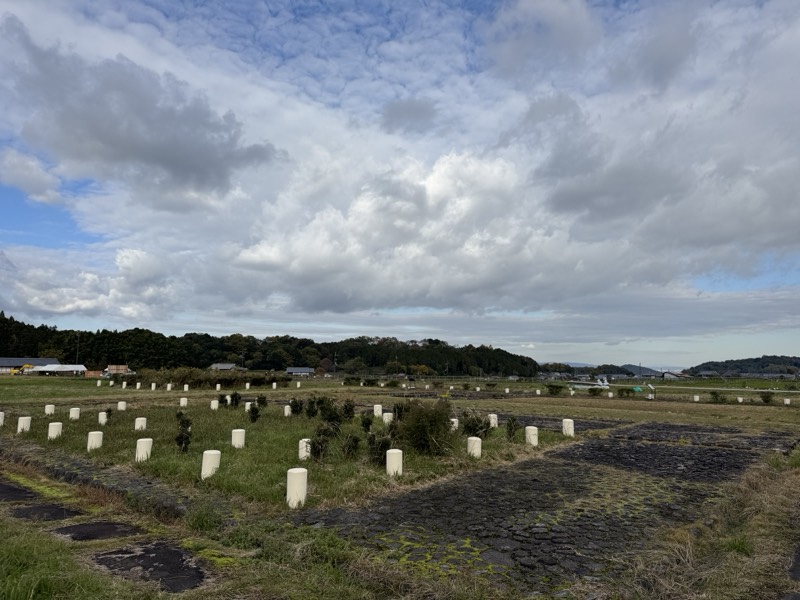
Then in the summer of 2016, seven large post holes, thought to have held banner poles, were found just south of the gate: one in the centre and three each to the east and west. Both the number and the arrangement matched the seven poles in the Shoku Nihongi.
It is rare for an event recorded in writing to be confirmed so directly as traces in the ground. The result of eight years of work, it is regarded as one of the most important recent discoveries at the Fujiwara Palace site.
Of the seven, only the central crow standard stood on the palace's north–south axis. It was also the southernmost of the seven, the one closest to the ranks of officials.
The arrangement of the other six has been read in terms of yin–yang and the Five Phases, the ancient Chinese idea that the world is made by the interplay of yin and yang and the cycling of five elements: wood, fire, earth, metal and water.
Each of the Four Beasts corresponds to a direction, a season and an element: the Azure Dragon of the east to spring and wood, the Vermilion Bird of the south to summer and fire, the White Tiger of the west to autumn and metal, the Black Tortoise of the north to winter and water. According to the Institute's explanation, the banners were set out to cycle in this order. The sun was on the east, the moon on the west, both placed off the central axis.
What the central crow stood for is still unsettled.
One view is that it was the Yatagarasu, the crow in the Kojiki and Nihon Shoki that guided Emperor Jinmu from Kumano to Yamato. It rests on the record of Emperor Junna's enthronement in 823, which mentions raising "the Yatagarasu and the forms of the sun and moon."
The other is that it was the sanzokuu, the three-legged crow that lives in the sun. The Muromachi-period Bun'an Gosokui Chōdozu, an illustrated record of enthronement regalia, notes beside the crow standard that "the crow has three legs." In Chinese myth the three-legged crow is the spirit of the sun, and it appears inside the sun in Goguryeo tomb paintings and on the Tamamushi Shrine at Hōryūji.
A researcher at the Institute, taking the three-legged-crow view, reads it this way: if the six banners of sun, moon and Four Beasts stand for yin and yang and for wood, fire, metal and water, then the central crow stands for the remaining element, earth. Earth represents the centre and the colour yellow, which fits a golden crow on the central axis. Since the emperor was held to descend from the sun goddess, the sun's crow was a sign of his legitimacy.

Sun and moon, and the Four Beasts: the same cast appears on the walls of Asuka tombs of the same period. The chamber of Takamatsuzuka Kofun was painted with the sun, the moon, the Azure Dragon, the White Tiger and the Black Tortoise, and Kitora Kofun with all four beasts.
Four Beasts guarding the dead inside a tomb, and Four Beasts lined up before the emperor at the palace on New Year's Day: the same set of ideas was at work in court ritual and in tomb design.
Banners continued to be raised at important ceremonies such as enthronements after the Nara period. But where they stood gradually changed.
At Fujiwara Palace the banners stood outside the gate, to the south; later they moved inside the gate, and at the Heian Palace they stood right in front of the Great Audience Hall. Their arrangement also changed, by the middle of the Nara period, to a single east–west line, and this was kept until the Edo period.
Why the arrangement became a straight line at Heijō Palace is not known. The seven holes at Fujiwara Palace are the starting point for tracing that change.
The pole holes were filled in after the excavation, and nothing shows on the surface today. The site of the Great Audience Hall survives as an earthen platform. Stand south of it and picture seven banners flying in the square before the gate. The hall to the north, Mount Kagu to the east, Mount Unebi to the west. On New Year's Day 701, the foreign envoys stood in this same landscape.
RELATED SPOT
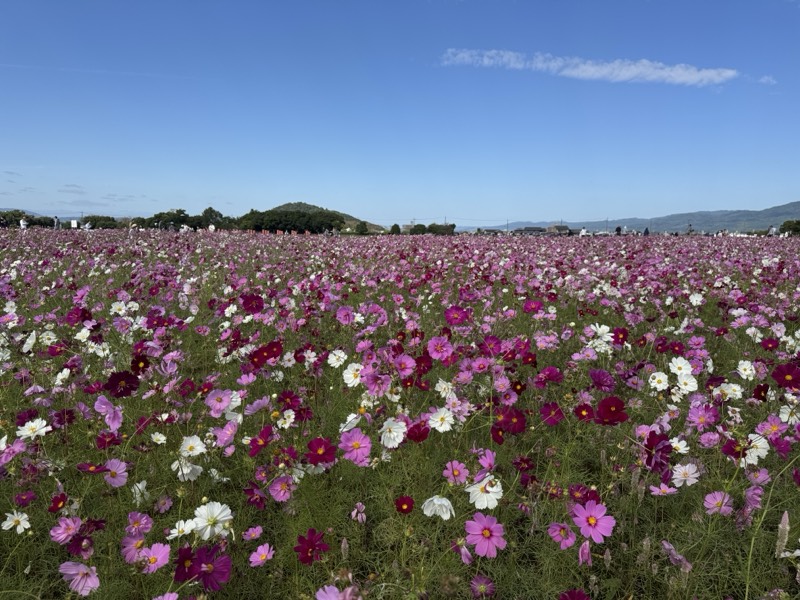
藤原宮跡
The heart of Japan's first full-scale planned capital, also known for its seasonal flower fields.
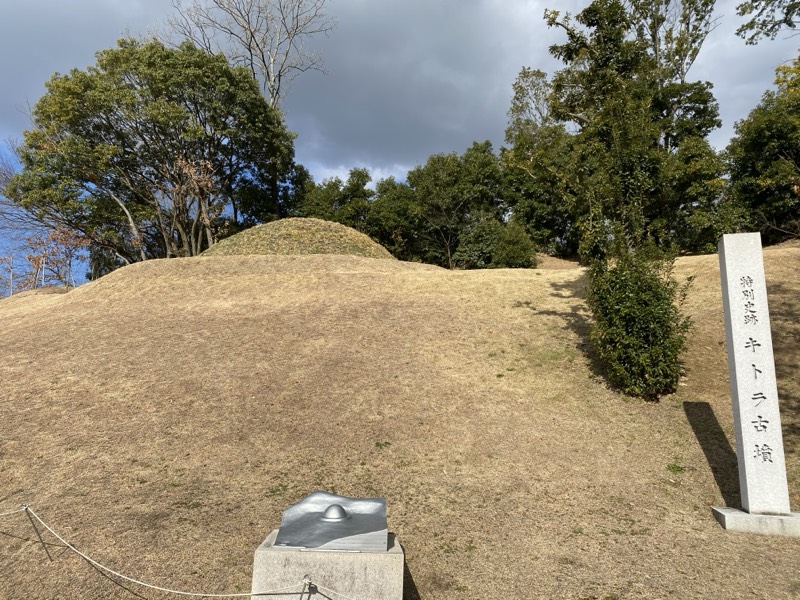
キトラ古墳
A two-tiered round burial mound famous for its chamber painted with the Four Gods and a map of the stars.
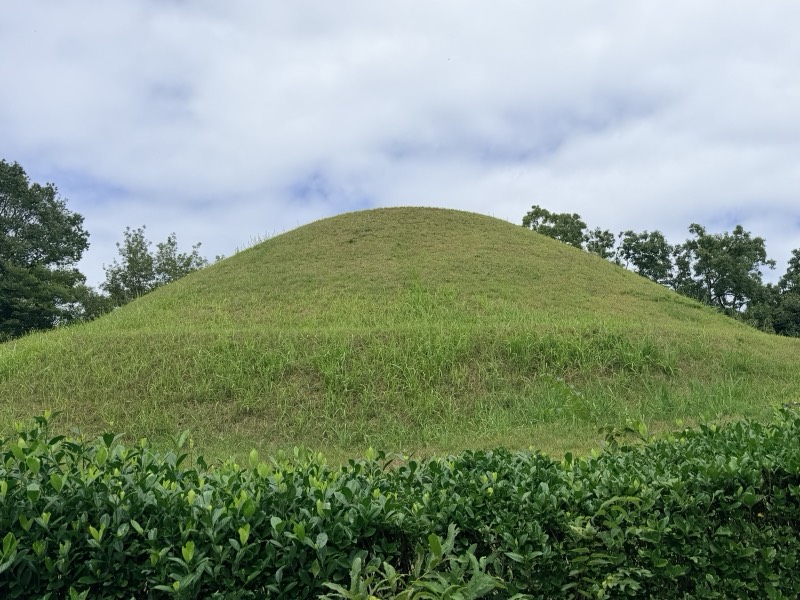
高松塚古墳
A round burial mound where brilliantly coloured paintings of court ladies were found: the defining archaeological discovery of post-war Japan.
RELATED COLUMN
 Buildings to Reach Heaven: Emperor Wu of Han's Dew Plates and the Two ZelkovasEmperor Wu of Han set up statues of immortals on bronze columns to catch the dew that fell from heaven. Was…
 Palace Design Did Not Advance in a Straight Line: Early Naniwa, Asuka and Fujiwara PalacesAfter the Isshi Incident of 645, a grand and orderly palace was built at Naniwa. Yet the palaces built after…Was Fujiwara-kyō a Confucian Capital? The City Without an Ancestral Temple or Altar of the LandFujiwara-kyō is widely thought to be a copy of the ideal capital described in the Confucian classic the Rites…