
Published
Two ropes of rice straw hang across the Asuka River. Downstream in Inabuchi a Shinto priest is invited; upstream in Kayanomori a Buddhist monk chants sutras. The same rite has carried on in a different form in each village.
Follow the Asuka River upstream and in two places you will find a rope stretched above your head. The one downstream in Inabuchi is the Ozuna, the "male rope"; the one further upstream in Kayanomori is the Mezuna, the "female rope".

Both are thick ropes twisted from rice straw, with a straw ornament hanging from the middle. The Ozuna represents a man and the Mezuna a woman.

The ropes are replaced every year. After a year of wind and rain a rope loses its colour and starts to unravel, and then a new one goes up. This is not a rite kept alive by preserving the same object for a long time, but by making it anew each year.
The ropes are not decoration. They are a boundary, meant to stop things coming in from outside.
Hanging a rope across the road and the river leading into the village marks the point beyond which nothing may pass. Tradition says it is to hold back evil diseases travelling along the road and the river into the village. At the same time, people pray for many descendants and good harvests.
This custom of "cutting the road" (michikiri) is not unique to Asuka Village. Stretching a rope across the entrance to a settlement is widespread throughout the Kinki region of western Japan. Such ropes are also called kanjō-nawa, and the same form survives in villages in Shiga and Mie prefectures.
The idea is to make a boundary visible. Not a wall, not a gate: a single rope is enough. It shows what passed along these routes, and what people wanted to keep out.
The most interesting thing about this rite is that, within the same valley, it is performed in two different ways.
Downstream, Inabuchi follows Shinto practice. A priest from Asuka-niimasu Shrine is invited to perform the prayers.
Upstream, Kayanomori follows Buddhist practice. An altar is set up on a stone called Fukuishi (the Lucky Stone), and the rope is hung after a monk has chanted sutras.

Go just a few kilometres up the river and a Buddhist monk comes instead of a Shinto priest. The rite is the same and has the same purpose, yet it has never been unified one way or the other; each village has kept its own way of doing it.
In the Meiji-era separation of Shinto and Buddhism (from 1868), Shinto and Buddhist rites were sharply divided in most places. In this valley, where that line falls has differed from village to village right up to the present day.
The ropes are not bought. They are made on the day, by twisting together rice straw collected from the terraced paddies.
In Inabuchi the work is done at the foot of the Kanjō-bashi bridge (神所橋). Three people twist the straw together, gradually building up a long rope. When it is finished it is carried to the Kanjō-bashi bridge (勧請橋) and hung over the river.
For a long time the ropes were tied to trees on either bank, but since 2023 Inabuchi has also used posts. The trees have weakened and there are fewer branches strong enough to hold the rope. To keep the rite going, the method is changing little by little.
The material is rice straw. That means the rite cannot take place unless rice has been grown that year.

The Inabuchi rice terraces are still maintained by hand. The paddies do not exist for the sake of the rite; the rite continues because the paddies do. A new rope each year also means that the rice ripened that year too.
The ropes are replaced just after the New Year. In Inabuchi this happens on Coming of Age Day, a national holiday in January. If you visit on that day, you can watch the whole process from twisting the straw to hanging the rope.
Even if you come on another day, the ropes themselves hang all year round. Head upstream from Inabuchi along Prefectural Road 15 and you will see the Ozuna overhead near the Kanjō-bashi bridge, and, further on, the Mezuna just before the village of Kayanomori. Both can be seen by looking up from the road.
From the Ozuna to the Mezuna takes a few minutes by car or about 30 minutes on foot. Seeing both in turn gives you a physical sense of the distance across which the same rite has kept two different forms in two villages.
RELATED SPOT
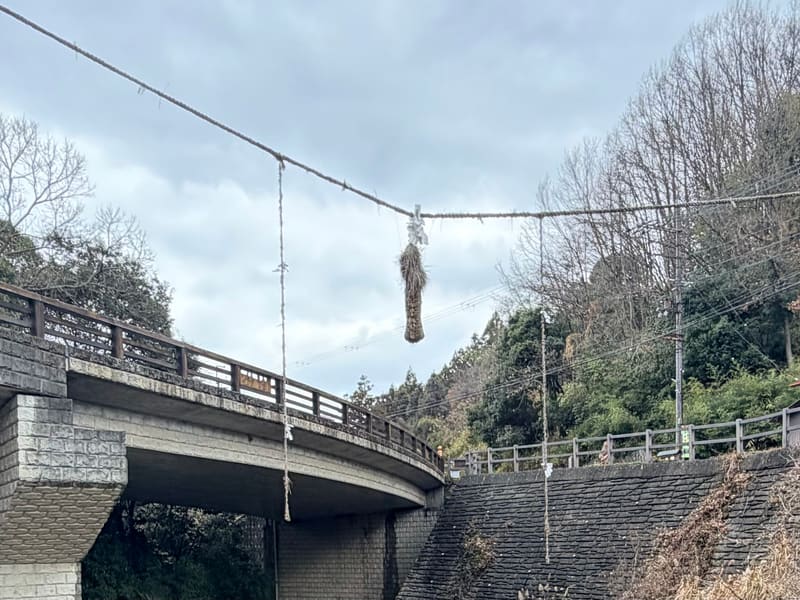
男綱
A rope of rice straw stretched across the Asuka River. It is replaced every year on Coming of Age Day.
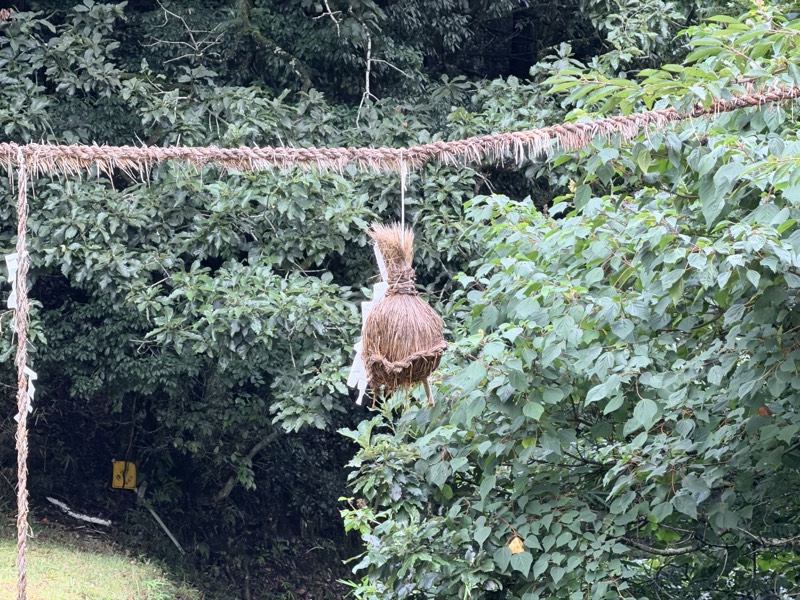
女綱
A rope of rice straw stretched across the upper Asuka River. It forms a pair with Ozuna (Male Rope) downstream.
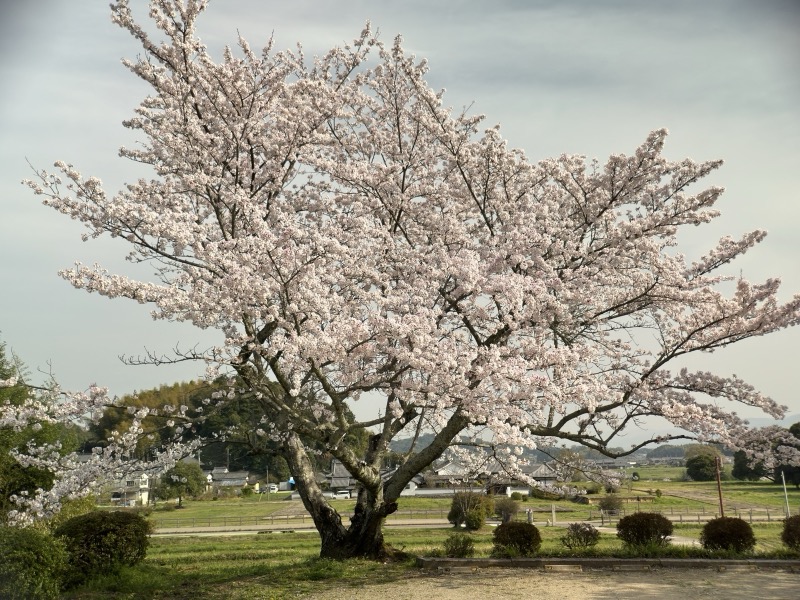
飛鳥川
The river that runs through the village, sung of in the Man'yōshū.
RELATED COLUMN
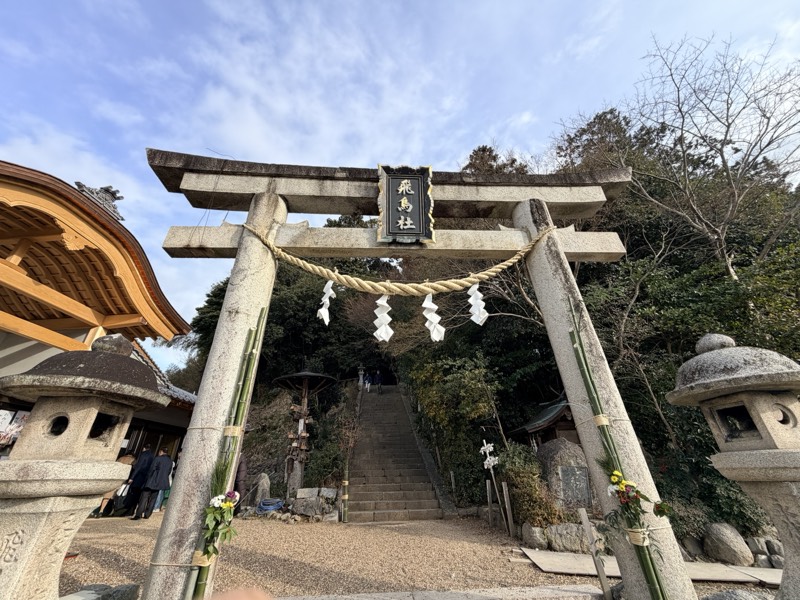 Onda Matsuri: Acting Out the Rice Farming Year, All the Way to MarriageOn the first Sunday of February, the grounds of Asuka-niimasu Shrine fill with people for a festival in which…
 The day Empress Kōgyoku prayed at the river's head: the rain rituals of 642Three kinds of rain-making were tried in turn, and when at last the empress prayed upstream on the Asuka…
 Remembered, Not Timed: Running the Asuka Half Marathon Past Ruins and Rice TerracesEvery March, 3,000 runners race past the historic sites and terraced rice fields of Asuka Village. Starting…