
Published
With few street lights, the sky seems to come closer once the sun goes down. And in this village, how the people of the Asuka period looked at the stars has survived intact.
Asuka Village has no large shopping centres and no bright billboards. Regulations protect the landscape, and at night little light is left but the lamps of the villages and the odd vending machine.
That is why the sky is so easy to see.


For about an hour after sunset, some blue remains in the sky. Only the brightest stars come out at this time.
Once it is fully dark, their number jumps. The ridgelines of the mountains drop away into clear black, and stars can be seen right down to just above them. In the centres of Nara City and Kashihara City, down on the floor of the basin, stars low in the sky are drowned out by light.

Winter is the easiest season. The air is dry and clear, and it is also the season when bright stars gather.
Once you find the three stars of Orion's Belt, you can use them to read the sky around them. Sirius is to the lower left and Procyon to the upper left; join them with Orion's Betelgeuse and you get a large triangle. Follow the line to the upper right and you reach Aldebaran and the Pleiades (Subaru).
Below the Belt is a small row known as the "little three stars" (Orion's Sword). Around there lies the Orion Nebula. To the naked eye it is just a fuzzy speck of light, but turn binoculars on it and you can see how it spreads, and through a telescope even the shapes of the gas appear.

In summer the Milky Way is visible, but humidity blurs the sky on many days, and the nights when you can see it are limited.
From here on, the story is one only this village can tell.
The ceiling of the stone chamber of Kitora Kofun (an ancient burial mound) was painted with an astronomical chart. Stars are shown as circles of gold leaf, and constellations are joined by lines of vermilion. There are about 350 stars and about 70 constellations. Circles representing the inner and outer limits of the visible sky, the celestial equator and the ecliptic are also drawn in.
It is said to be the oldest surviving star chart in the world drawn from actual astronomical observation. And it was on the ceiling of a tomb built between the late 7th and early 8th century.
The ceiling of Takamatsuzuka Kofun also has constellations in gold leaf. They are not as precise as Kitora's, but the layout is the same: groups of figures on the east and west walls, the Four Guardian Beasts on the four sides, and stars on the ceiling.
Inside the stone chamber, earth and heaven were recreated together. The dead were laid to rest beneath the stars.
There was also a building for watching the stars.
The Nihon Shoki (Japan's oldest official chronicle, compiled in 720) records that in the first month of the fourth year of Emperor Tenmu's reign (675) a Senseidai, a "star-divining platform", was built. It is considered Japan's first observatory. Where it stood is not known.
An entry from before Emperor Tenmu came to the throne describes him as skilled in astronomy and tonkō (a Chinese art of divination), meaning he was well versed in reading the movements of the heavens. There is even a scene in which he observes an eclipse and makes a decision in the middle of the Jinshin War.
Under the later ritsuryō (law codes), a doctor of astronomy was posted in the government office called the Onmyōryō (Bureau of Yin and Yang). His duties were to observe the stars and, if anything unusual appeared, report it directly to the emperor.
It was not a hobby.
In the thinking of the time, disturbances in the heavens were tied to politics on earth. A comet appearing, a star falling, the sun being eclipsed: all were read as omens of something about to happen.
So observation was kept under state control, and the results were kept secret. Anomalies found by the doctor of astronomy were to be reported to the emperor in secret. Spreading the art of reading the stars among ordinary people was the same as talking politics.
It was an age when watching the stars was the state's business.
The Nihon Shoki preserves a number of sky disturbances recorded in this way.
Among the best known is an entry for the twelfth month of the 28th year of Empress Suiko's reign (620): "There was a red vapour in the sky, more than one jō long [about 3 m], shaped like the tail of a pheasant." That is, a red light appeared in the sky, a little over one jō in length, shaped like a pheasant's tail.
One theory holds that this describes a low-latitude aurora. When solar activity is high, red auroras can sometimes be seen even in Japan. If so, it would be the oldest record of an aurora in Japan.
A red light spreading out like a fan. "Like a pheasant's tail" captures that shape well. Someone looked up at this sky and wrote it down.

You do not need anywhere special. Walk a little way out of a village onto a road without street lights and you will see them.
The observation deck on Amakashi Hill, Asakaze Pass, the area around the Inabuchi rice terraces, and Oku-Asuka (the upper Asuka valley): all have little light around them and a wide view of the sky.
But all of them are truly pitch dark at night. There are no street lights. Always bring a light for your feet. On the terraces and the pass roads, the paving gives out in places, and some roads have a drop on one side.
To be honest, it is not complete darkness.
The low sky from north to west is faintly brightened by the lights of the towns in the Nara basin. The darkest direction is south, towards Yoshino, and the easiest area to observe is from overhead down to the south.
Even so, the number of stars cannot be compared with what you see in a city. You can make out with the naked eye the small stars dotted in a row below Orion's Belt.
At night, Asuka is where people live their lives.
Do not park on the road. Do not point your headlights at houses. Keep your voice down. Do not walk onto paddy ridges or private land. These are obvious things, but in the dark it is easy to misjudge distances.
Winter is cold. It gets colder here than on the basin floor, and the stiller the night, the harder the chill.
The positions of the stars do not visibly change in 1,300 years.
The person who painted the stars on the Kitora ceiling, the people who looked up from the Senseidai, the person who wrote "a red vapour in the sky": all of them saw almost the same stars you can see now.
Most of what survives in this village is stone walls and remains under the earth. Among them, the night sky may be one of the few things left just as it was.
RELATED SPOT
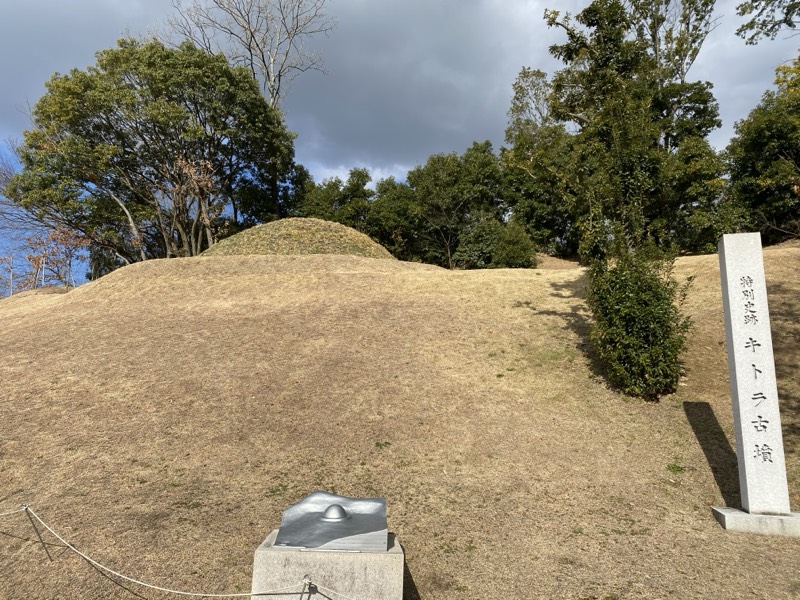
キトラ古墳
A two-tiered round burial mound famous for its chamber painted with the Four Gods and a map of the stars.
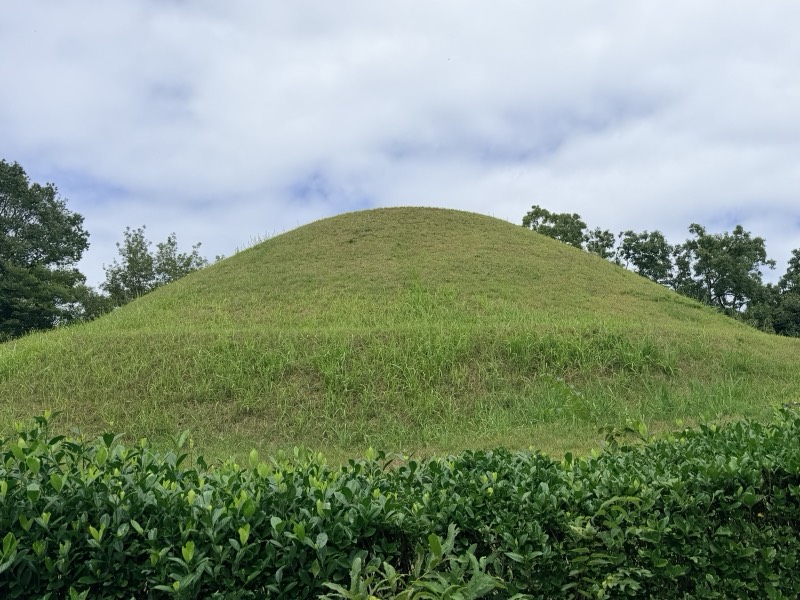
高松塚古墳
A round burial mound where brilliantly coloured paintings of court ladies were found: the defining archaeological discovery of post-war Japan.
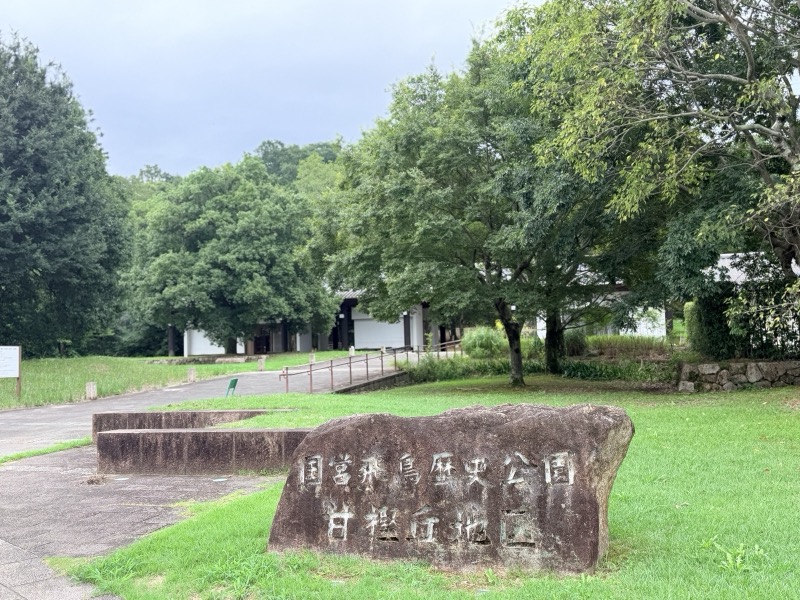
甘樫丘
A hill with views over all of Asuka, said to have been the site of the Soga clan's residences.
RELATED COLUMN
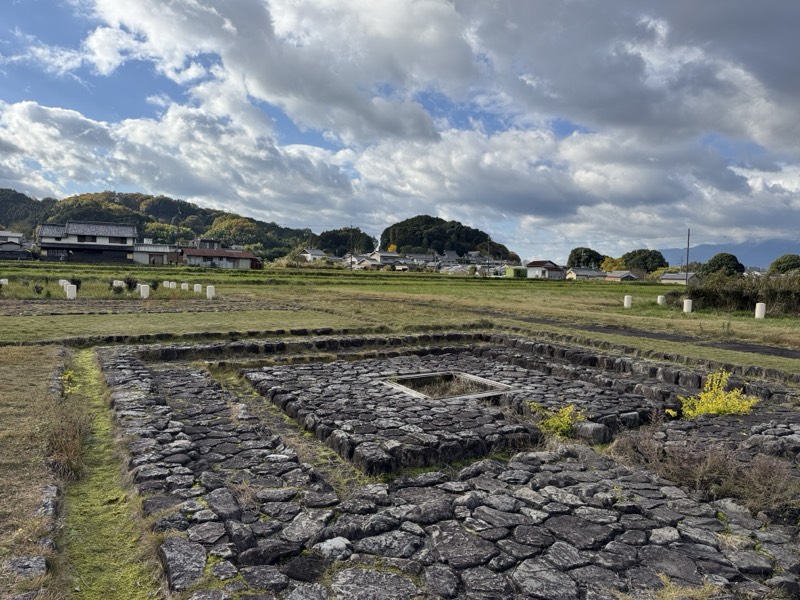 Asuka-Fujiwara World Heritage: All 19 Component Sites and How to Visit Them, with Half-Day, One-Day and Two-Day Routes"Asuka-Fujiwara" was inscribed on the World Heritage List in 2026. We list all 19 component sites with their…They Didn't Stop at Digging: Half a Century of Asuka Village and Kansai UniversityThe team that uncovered the wall paintings of Takamatsuzuka Kofun in 1972 came from Kansai University. A…
 Whose Tomb Is the Mausoleum of Emperor Kinmei?Several theories have been put forward about who is buried in the largest keyhole-shaped tomb in Asuka…