


1 / 2
飛鳥京跡苑池(あすかきょうあとえんち)
The site of a palace garden, regarded as the earliest example of a Japanese garden.
This is the site of a garden built as part of the palace, adjoining the north-west side of the Asuka Palace Site. Analysis of finds and stonework shows that it was built during the time of Empress Saimei's Later Asuka-Okamoto Palace (656–667) and was used as the palace garden until the Asuka-Kiyomihara Palace of Emperor Tenmu and Empress Jitō (672–694). It appears to have been remodelled around the reign of Emperor Tenmu.
In 2003 it was designated both a Historic Site and a Place of Scenic Beauty of Japan. It is the only place in Asuka designated a Place of Scenic Beauty.
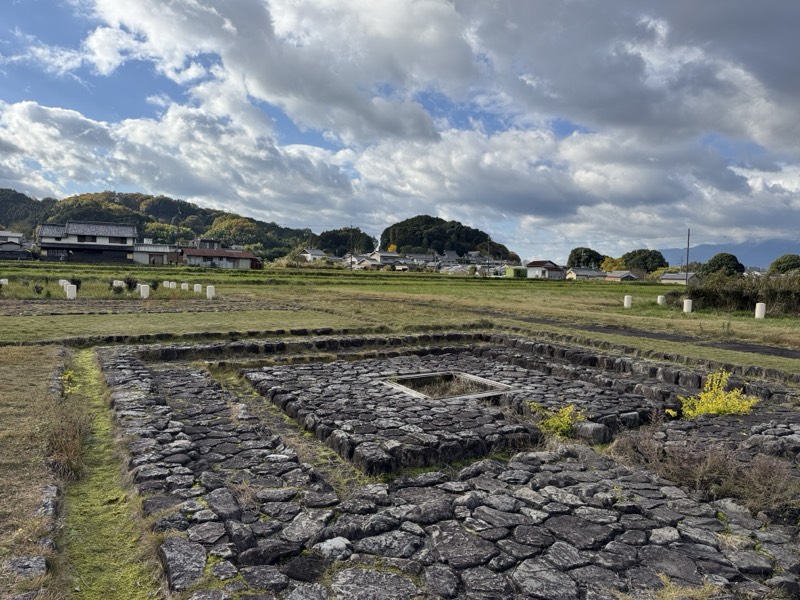
The garden is divided into a South Pond and a North Pond by a central embankment. They were not completely separate, though: a wooden pipe buried in the embankment connected them, so that water flowed from the South Pond into the North Pond.
The South Pond is five-sided. Its banks were built of piled stone and its bed was paved with stones. There were two islands in the pond. It was built not just to hold water but to be looked at.
Around the stone objects and the islands there are thought to have been features such as running water or fountains. To the north-east of the North Pond, facilities for spring water and for channelling water were also found. This suggests that some of the stone objects of unknown purpose scattered around Asuka may have been garden fixtures like these.
Gardens attached to palaces are known from the Korean Peninsula as well as China. The Asuka Palace Garden shares some features with gardens on the Korean Peninsula, suggesting that the techniques of garden-making were brought by immigrants.
At the same time, its design and structure include elements found only in Japan. Techniques brought in from outside were reworked here.
For this reason, the Asuka Palace Garden is regarded as the earliest example leading to the later Japanese garden.
The Nihon Shoki (Japan's oldest official chronicle, compiled in 720) records that in the 11th month of 685 Emperor Tenmu went out to the "Shiranishiki no Misono" (White Brocade Garden).
This garden is thought quite likely to be that Shiranishiki garden. If so, the oldest garden in Japan whose name we know lies beneath this grassland.
On 26 July 2026 it was inscribed on the World Heritage List as one of the component parts of "Asuka-Fujiwara: Archaeological Sites of Japan's Ancient Capitals and Related Properties."
Excavation is continuing and the site is still being prepared for visitors. For now it is an open grassy field, and apart from the reconstruction drawings on the information board there is little to help you trace the ponds. It lies just north-west of the Asuka Palace Site, so you can visit both together.
Published
NEARBY
飛鳥宮跡(伝 飛鳥板蓋宮跡)
The political heart of Asuka, where several palaces were built one on top of another.
飛鳥川
The river that runs through the village, sung of in the Man'yōshū.
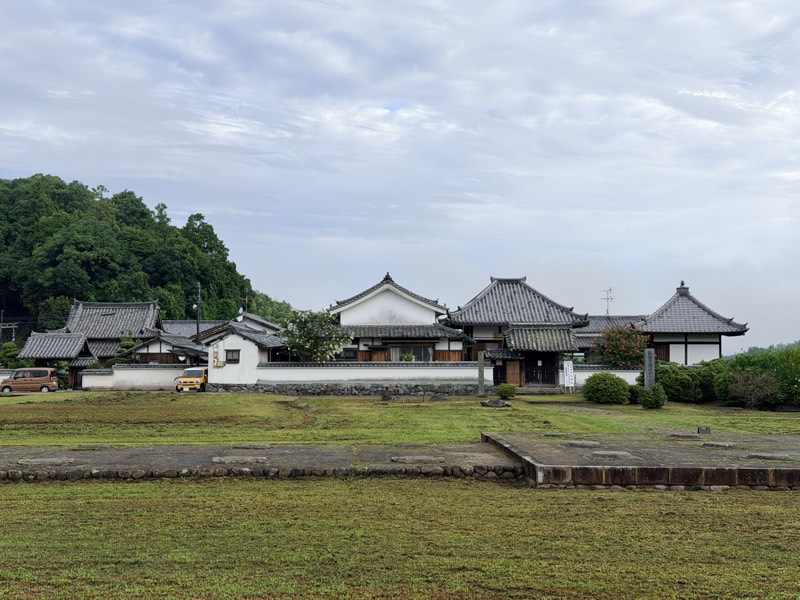
川原寺跡(弘福寺)
One of the four great temples of Asuka. Its foundation stones still show how large its halls once were.