


1 / 5
酒船石(さかふねいし)
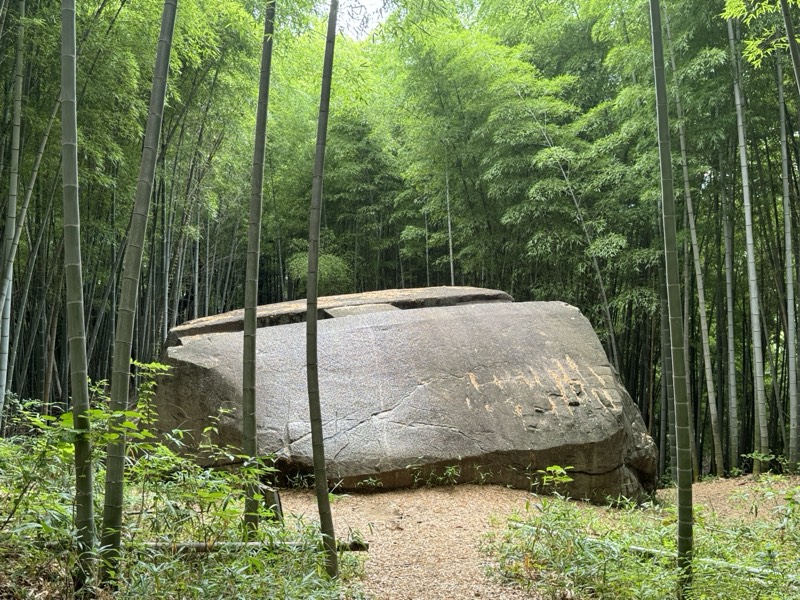
A mysterious stone carved with circles and channels, lying in a bamboo grove on top of a hill.
In a bamboo grove on top of a hill lies a flat slab of granite, about 5.5 m long, 2.3 m wide and 1 m thick. It was designated a National Historic Site in 1927.
Its top is carved with round hollows, large and small, linked by narrow channels in an almost symmetrical, geometric pattern. It was clearly some kind of device, but no one knows what.
The stone is not complete. Parts of its north and south ends are missing, probably carried off somewhere in the Edo period (1603–1868) or thereabouts. Marks left by the tools used to split them off can still be seen along its edges.
The name Sakafune, "sake vessel," comes from a view held since the Edo period that it was used for brewing sake.
Other suggestions include a press for oil or medicinal herbs, a device for displaying flowing water in a garden, or an object used in religious rituals.
What is certain is that liquid poured into the hollows would run down through the channels, but what flowed through them is not known.
One clue is water. About 40 m east of the stone, on slightly higher ground, clay pipes and a stone conduit were found that brought water here. The theory that it was part of a garden is based on this.
For a long time the stone was treated as a mysterious monument on its own. That changed in 2000.
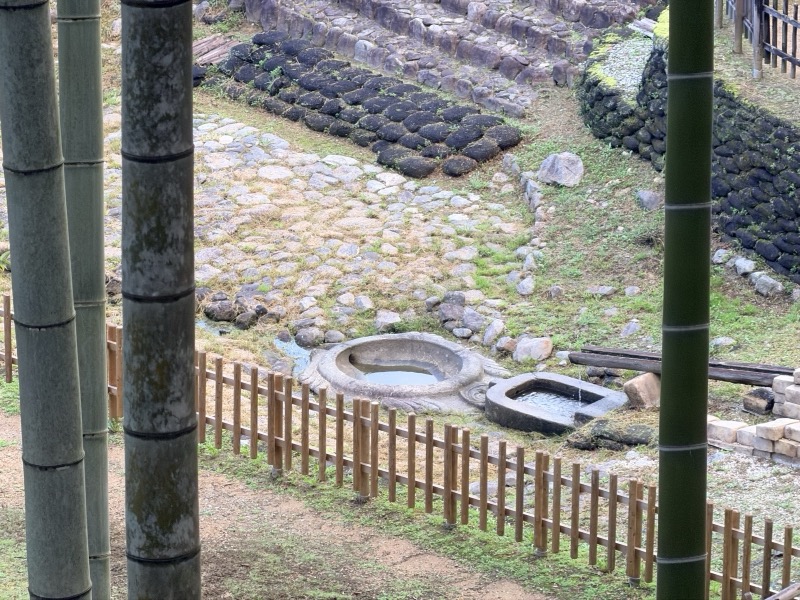
At the northern foot of the hill, a turtle-shaped stone basin and an oval stone basin were discovered, together with a spring-water facility that fed them. The Sakafuneishi on the hilltop and the water facilities at the foot of the hill came to be considered a single site, called the Sakafuneishi Remains.
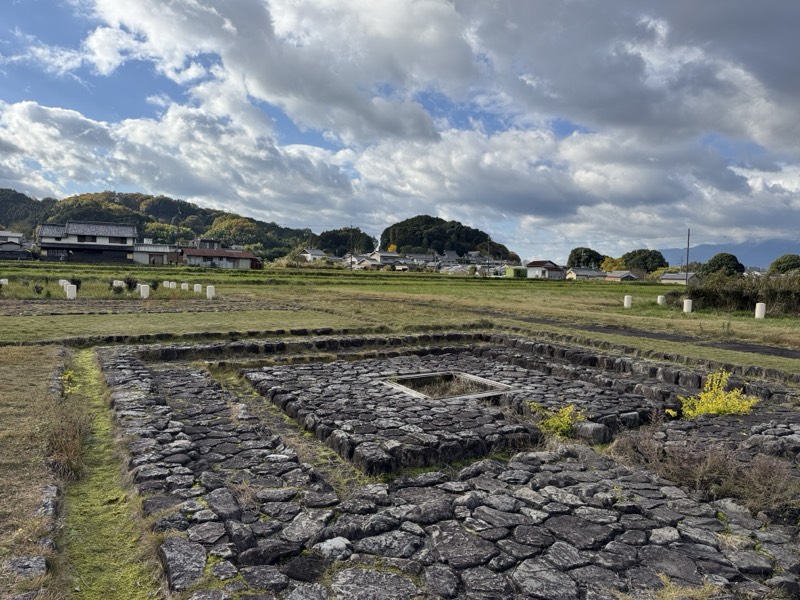
At the same time, stone walls of cut sandstone were found running in terraces around the slopes of the hill. The hill itself had been shaped by human hands.
The Nihon Shoki, Japan's oldest official chronicle, records that Empress Saimei built the "Futatsuki Palace" on top of a hill enclosed by stone walls. It also says that many labourers were drafted for the work, and that it was condemned as "the canal of a mad mind."
The view that the Sakafuneishi Remains are what this account describes has become the leading one. Enclosing a hill with stone, bringing in water and placing a structure on its summit is thought to be part of the large-scale construction projects Empress Saimei carried out again and again.
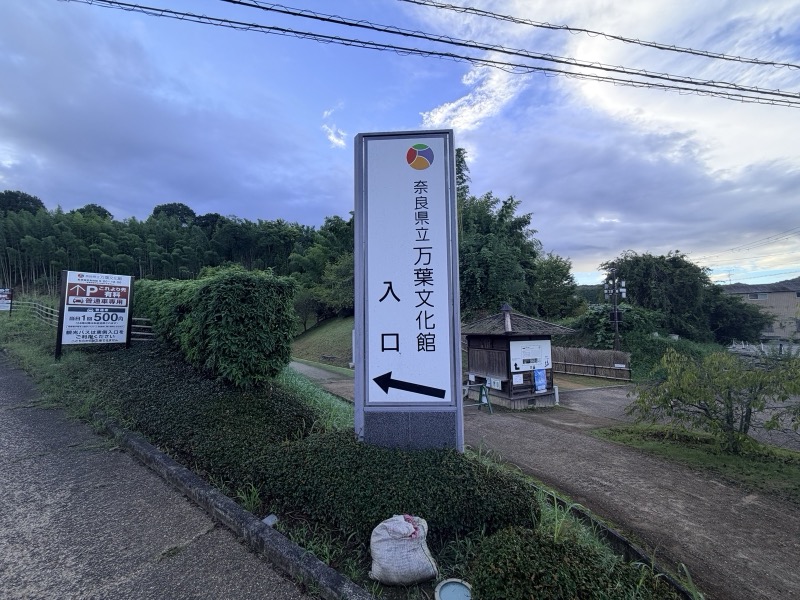
Take the Asuka loop bus from Kintetsu Kashiharajingu-mae Station to the "Man'yō Bunkakan Nishiguchi" stop, then walk about 5 minutes up a sloping path through the bamboo. There is no admission fee.
The turtle-shaped stone basin at the foot of the hill charges an admission fee and has set opening hours. Visiting both shows you how the top and bottom of the hill are connected.
Published
READ MORE
 What Were They Made For? Asuka's Mysterious StonesTwo holes cut into an 800-tonne boulder, a slab carved with circles and channels, a turtle with a face…
 Asuka-Fujiwara World Heritage: All 19 Component Sites and How to Visit Them, with Half-Day, One-Day and Two-Day Routes"Asuka-Fujiwara" was inscribed on the World Heritage List in 2026. We list all 19 component sites with their…
NEARBY
亀形石造物
A ritual site from the reign of Empress Saimei, with stonework designed to channel water.
奈良県立万葉文化館
A centre for ancient culture built around the Man'yōshū.
飛鳥宮跡(伝 飛鳥板蓋宮跡)
The political heart of Asuka, where several palaces were built one on top of another.