
Published
Two holes cut into an 800-tonne boulder, a slab carved with circles and channels, a turtle with a face, statues with faces on both sides: in Asuka, stones whose purpose no one knows still lie scattered among the fields and hills. We tour them, sorted into mysteries solved, half-solved, and still completely open.

In and around Asuka Village stand a number of stone monuments whose purpose is unknown: Kameishi, Sakafuneishi, the Saruishi, the Nimenseki and the Masuda no Iwafune. All are laboriously carved from hard granite. Yet no one knows when, by whom, or why they were made.
So many have survived together, it is thought, both because this was the capital for a long time and because the area escaped large-scale development from the Middle Ages onward. The unanswered stones have simply been left in the fields and on the hills.
Deep in a bamboo grove on a hill in Kashihara, west of Asuka Village, lies one of the largest of all Asuka's stone monuments: about 11 m east to west, 8 m north to south and 4.7 m high, with an estimated weight of around 800 tonnes.
Its flattened top has two square holes side by side, each about 1.6 m across and 1.3 m deep. Grid-like grooves on its sides show that the carving stopped partway through.
The leading theory is that it was meant to become the stone burial chamber of a kofun (ancient burial mound) but was abandoned. If the two holes are seen as two burial chambers, the structure closely resembles the chamber of Kengoshizuka Kofun, and it is thought the work stopped when the stone cracked. Other theories call it an astronomical platform, a lookout, or a tomb for cremated remains; none is conclusive.
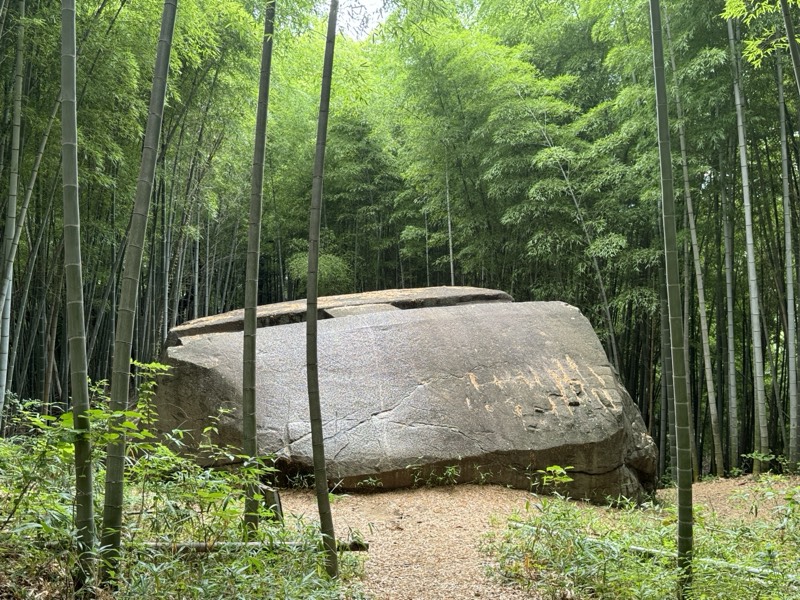 SPOTMasuda no Iwafune (Masuda Rock Boat)益田岩船A giant stone lying deep in a bamboo grove. No one knows what it was made for.Access: About 20 minutes on foot from Kintetsu Okadera StationSee the spot page →
In a bamboo grove on a hilltop, the Sakafuneishi is a flat stone about 5.5 m long, its top carved with round hollows and fine channels in an almost symmetrical pattern. Pour in a liquid and it runs along the channels, but what was poured is unknown. Brewing sake, pressing oil or herbs, displaying flowing water in a garden, ritual use: many theories have been put forward.
A discovery in 2000 changed how this long-isolated mystery is seen. At the northern foot of the hill, a facility was found that channelled spring water into oval and turtle-shaped stone basins. The hillside also proved to have been faced with stone walls, and the hilltop and its foot are now known together as the Sakafuneishi Site.
The Nihon Shoki (Japan's oldest official chronicle, compiled in 720) records that Empress Saimei built the Futatsuki Palace on a hill surrounded by stone walls, and that the work was condemned as a "canal of a mad mind". The view that the Sakafuneishi Site corresponds to this record has become the leading one. The stone's own purpose is still undecided, but the kind of place it stood in is coming into view.
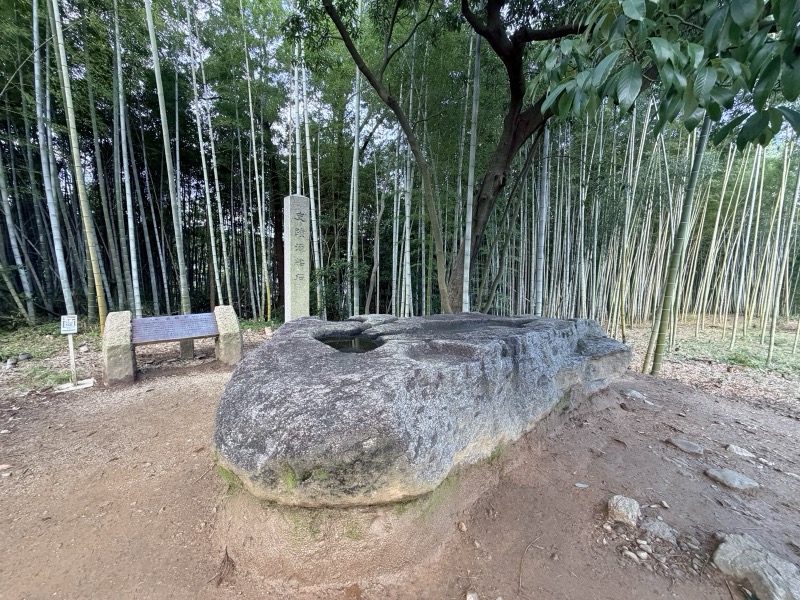 SPOTSakafuneishi酒船石A mysterious stone carved with circles and channels, lying in a bamboo grove on top of a hill.Access: About 5 minutes on foot from the "Man'yō Bunkakan Nishiguchi" stop on the Asuka loop bus from Kintetsu Kashiharajingu-mae StationSee the spot page →
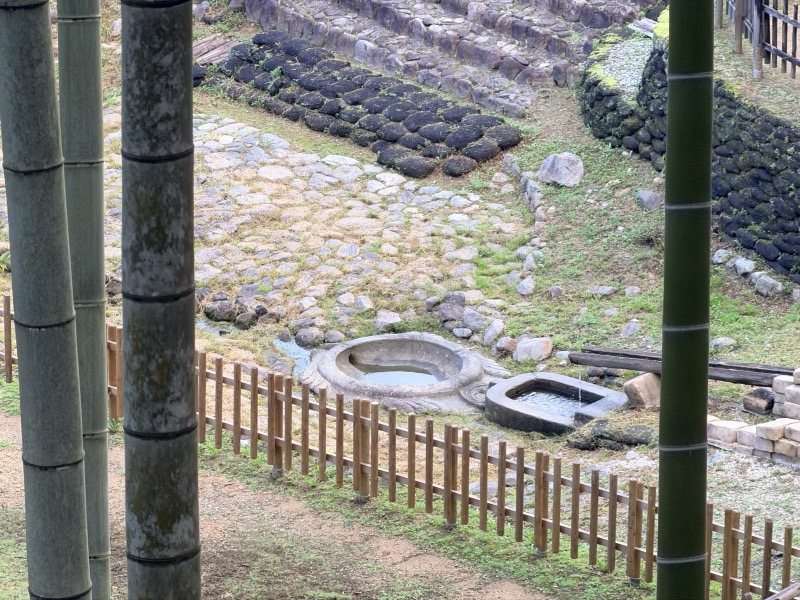 SPOTKamegata Sekizōbutsu (Turtle-shaped Stone Basin)亀形石造物A ritual site from the reign of Empress Saimei, with stonework designed to channel water.Access: About 3 minutes on foot from the "Man'yō Bunkakan Nishiguchi" stop on the Asuka loop bus from Kintetsu Kashiharajingu-mae StationSee the spot page →
Some mysteries have been linked to the written record. In the Meiji era, two stone sculptures were dug out of the rice fields at the Ishigami Site, northwest of Asuka-dera: the Shumisen-seki (Mount Sumeru Stone) and the Sekijin-zō (Stone Figures). Both were hollowed out inside and designed to spout water.
The Nihon Shoki mentions several times that Empress Saimei made a likeness of Mount Sumeru and entertained the Emishi and foreign envoys. The Ishigami Site is thought to have been a banqueting facility, which makes the stones fountains for entertaining guests. The originals are displayed at the Asuka Historical Museum, and copies stand in its garden.
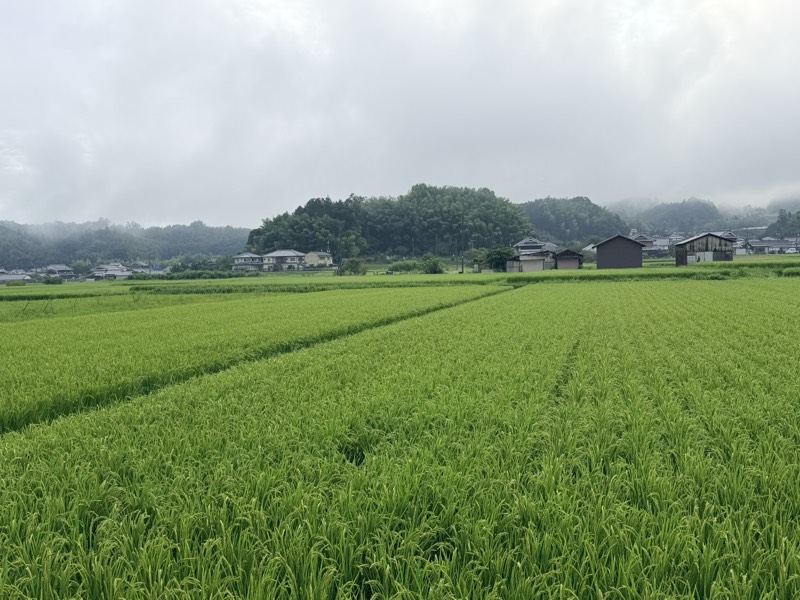 SPOTIshigami Site石神遺跡Empress Saimei's banquet grounds, where the Shumisen Stone was unearthed.Access: Right by the "Asuka" stop on the Asuka loop bus from Kintetsu Kashiharajingu-mae StationSee the spot page →
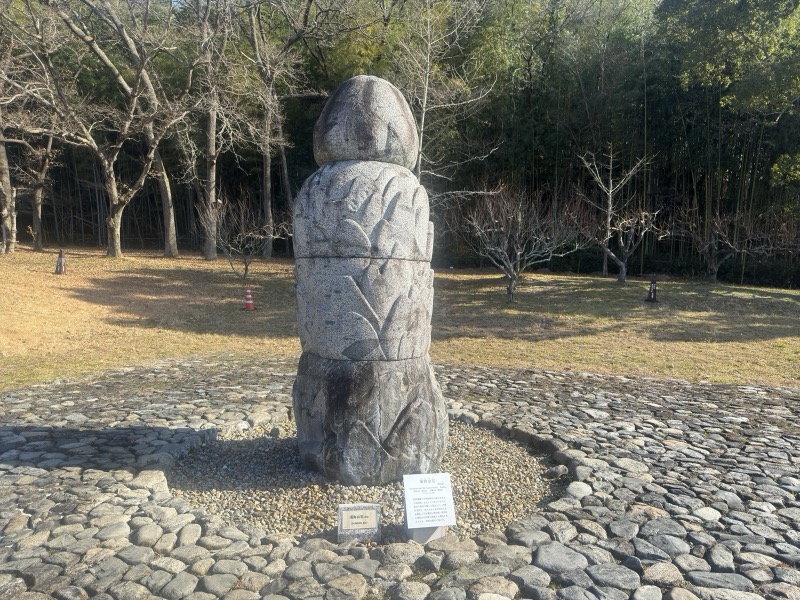 SPOTAsuka Historical Museum (Nara National Research Institute for Cultural Properties)奈良文化財研究所 飛鳥資料館The Nara National Research Institute's museum, displaying finds from Asuka and the east corridor of Yamada-dera Temple.Access: Right by the "Asuka Shiryōkan" bus stop, by bus from Kintetsu Kashiharajingu-mae Station or Sakurai StationSee the spot page →
Some stones have mysterious names even though their purpose is known. The flat "Demon's Chopping Board" (Oni no Manaita) at the top of a slope and the "Demon's Toilet" (Oni no Setchin) lying by the road below were once the stone chamber of a single kofun: the chopping board is the base, the toilet the lid. The earth mound was lost, and the lid tumbled down the slope, ending up with its inside facing out.
The names come from a legend of a demon who led travellers astray in the fog, cooked them on the chopping board and relieved himself in the toilet. Villagers gave names to stones they could not explain by telling stories about them.
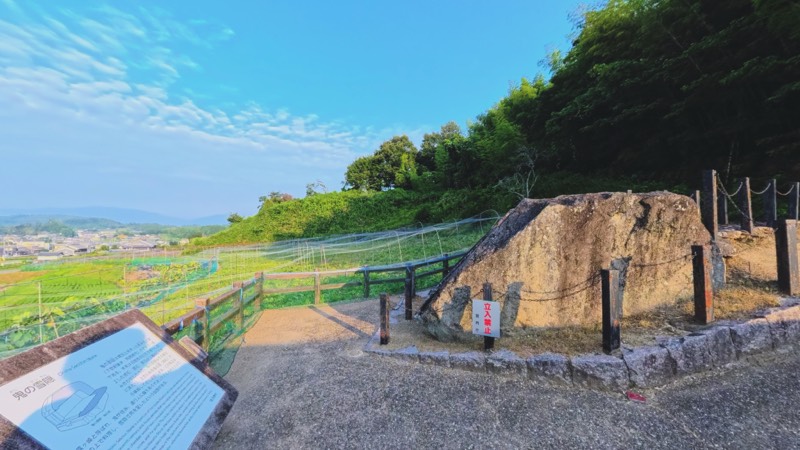 SPOTOni no Manaita and Oni no Setchin (the Ogre's Chopping Board and Toilet)鬼の俎・鬼の雪隠The pieces of a kofun burial chamber, split apart on either side of a slope.Access: About 12 minutes on foot from Kintetsu Asuka StationSee the spot page →
Kameishi is a stone about 3.6 m long crouching by the road in Kawahara. Carved eyes and a mouth give it a turtle's face. It has been called a boundary marker of Kawara-dera temple, or a stone from a garden or ritual site, but nothing is conclusive, and it is not even certain that it dates from the Asuka period. Its lower part is buried, so its full shape is unknown. What is well known is the legend that when it turns to face west, Yamato will sink into a sea of mud.
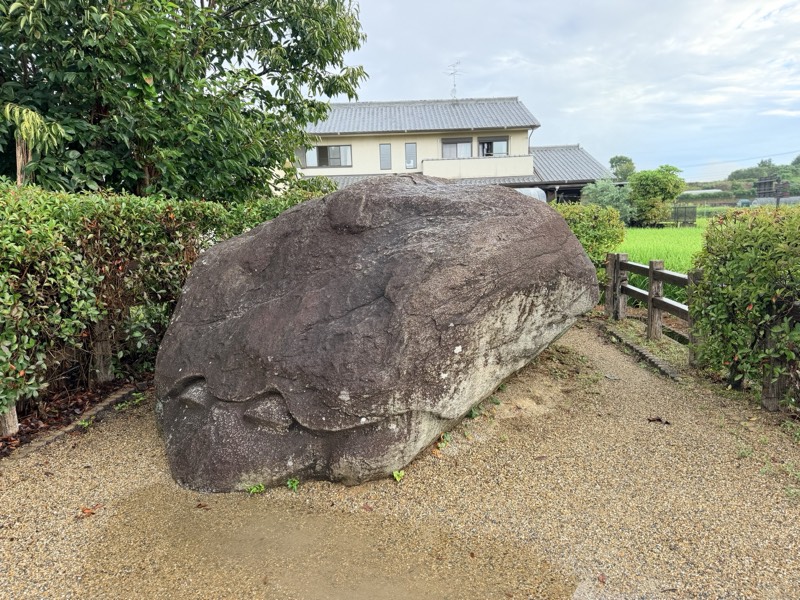 SPOTKameishi (Turtle Stone)亀石A granite boulder with a turtle's face, loved for its friendly look. One of Asuka's best-known stone monuments.Access: About 20 minutes on foot from Kintetsu Asuka StationSee the spot page →
The Saruishi (Monkey Stones) are four stone figures inside the fence of Princess Kibi's tomb, south of Emperor Kinmei's mausoleum. They were dug out of a nearby rice field in 1702 and moved here. Each has faces carved on both front and back. Theories say they depict immigrants or served as roadside guardian deities, but what they represent, and where they originally stood, is unknown.
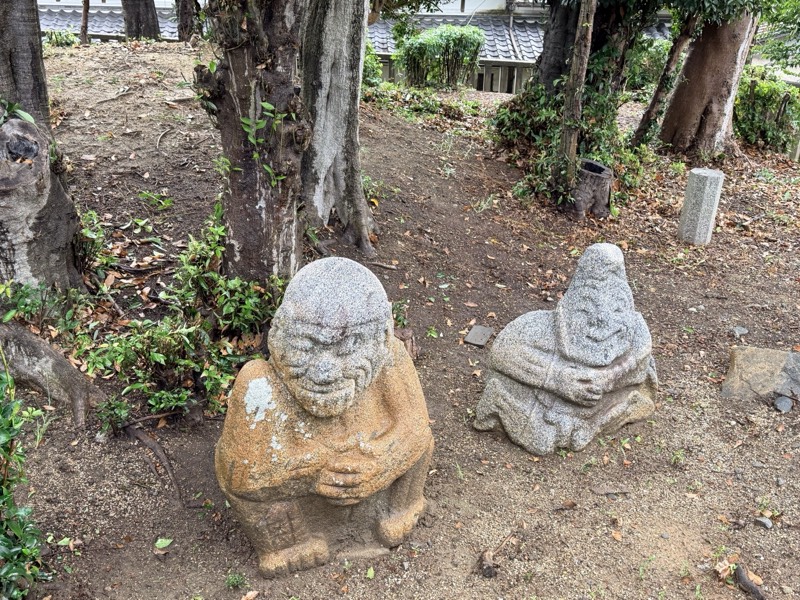 SPOTTomb of Princess Kibihime and the Saruishi (Monkey Stones)吉備姫王墓・猿石Four stone figures known as the Saruishi stand in the tomb grounds. What they were for is still a mystery.Access: About 10 minutes on foot from Kintetsu Asuka StationSee the spot page →
The Nimenseki (Two-Faced Stone) in the grounds of Tachibana-dera is a stone about 1 m high with a face carved on each side. They are said to be the faces of good and evil, representing the two sides of the human heart, but when and why it was made is unknown.
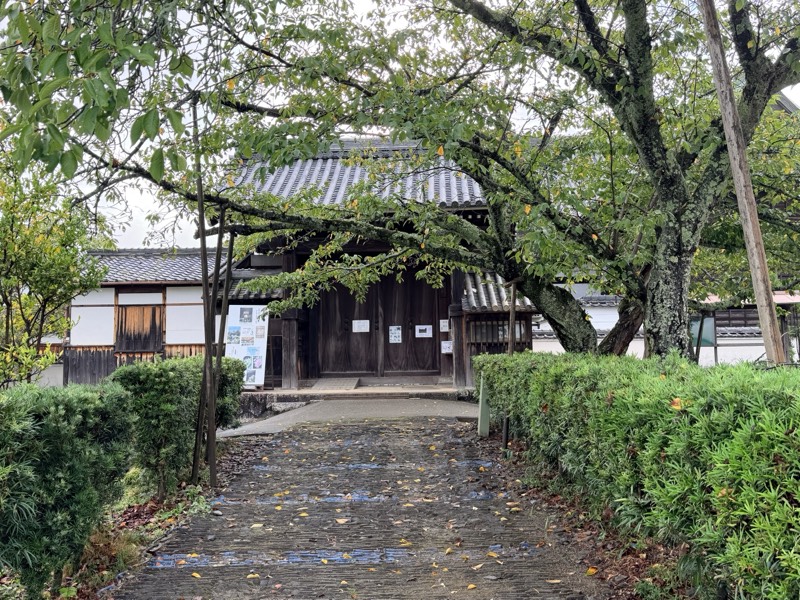 SPOTTachibana-dera Temple橘寺The temple said to stand on the birthplace of Prince Shōtoku, home to the two-faced Nimenseki stone.Access: About 3 minutes on foot from the "Kawahara" stop on the Asuka loop bus from Kintetsu Kashiharajingu-mae StationSee the spot page →
The Maraishi lying by the road in Iwaido is a stone about 125 cm long, thought to represent a phallus. One theory pairs it with the hill across the Asuka River, called Fuguri-yama, and the information board suggests it may be connected with prayers for descendants or with agricultural belief.
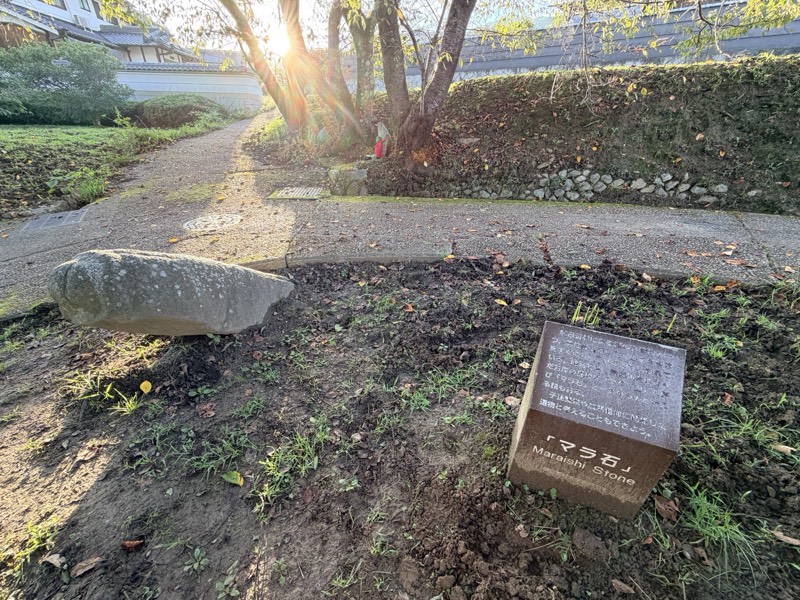 SPOTMaraishi (Phallic Stone)マラ石A phallus-shaped stone lying by the roadside. One theory pairs it with "Fuguri-yama" on the opposite bank.Access: About 8 minutes on foot from the "Ishibutai" stop on the Asuka loop bus from Kintetsu Kashiharajingu-mae StationSee the spot page →
Mirokuishi, beside the Asuka River, is a pillar-like boulder with only slight carving where the eyes and mouth would be. No one knows what it is, but it is affectionately called "Miroku-san" and believed to cure illnesses of the lower body, and flowers are still offered to it. Even without a known origin, the stone keeps a role in village life.
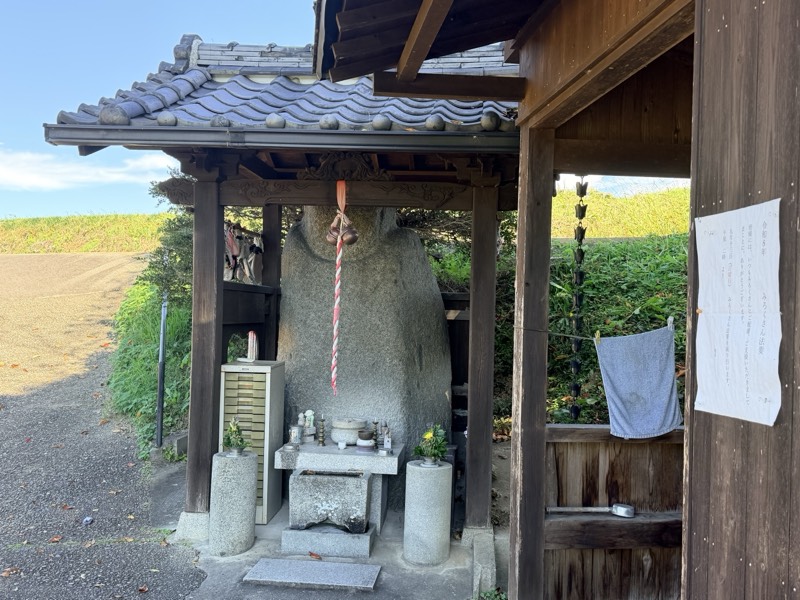 SPOTMirokuishi (Maitreya Stone)弥勒石A pillar-like boulder on the right bank of the Asuka River. Believed to cure ailments of the lower body, it is affectionately called "Miroku-san."Access: About 6 minutes on foot from the "Asuka Daibutsu-mae" stop on the Asuka loop bus from Kintetsu Kashiharajingu-mae StationSee the spot page →
Both the Sakafuneishi Site and the Shumisen-seki are thought to date from the reign of Empress Saimei (655–661). Surrounding a hill with stone walls, bringing in water, carving stone into fountains and basins: Saimei undertook one grand project after another, and her works were even called a "canal of a mad mind".
It is tempting to imagine that some of the stones of unknown purpose are also connected with the building works of this age, but no evidence to confirm it has yet been found.
Walking from Asuka Station, the Oni no Manaita and Oni no Setchin, the Saruishi, Kameishi and Tachibana-dera's Nimenseki lie along a single route. The Sakafuneishi and the Turtle-Shaped Stone Basin are east of the Asuka Palace Site, the Maraishi south of Ishibutai Kofun, and Mirokuishi on the Asuka River west of Asuka-dera. Only the Masuda no Iwafune is outside the village, about 20 minutes up a mountain path through bamboo from Kintetsu Okadera Station.
To see the Shumisen-seki, the Sekijin-zō and a copy of the Saruishi in one place, visit the Asuka Historical Museum. Standing before a stone that has no answer and coming up with your own theory is one of the pleasures of Asuka.
RELATED SPOT
益田岩船
A giant stone lying deep in a bamboo grove. No one knows what it was made for.
酒船石
A mysterious stone carved with circles and channels, lying in a bamboo grove on top of a hill.
亀形石造物
A ritual site from the reign of Empress Saimei, with stonework designed to channel water.
亀石
A granite boulder with a turtle's face, loved for its friendly look. One of Asuka's best-known stone monuments.
吉備姫王墓・猿石
Four stone figures known as the Saruishi stand in the tomb grounds. What they were for is still a mystery.
橘寺
The temple said to stand on the birthplace of Prince Shōtoku, home to the two-faced Nimenseki stone.
マラ石
A phallus-shaped stone lying by the roadside. One theory pairs it with "Fuguri-yama" on the opposite bank.
鬼の俎・鬼の雪隠
The pieces of a kofun burial chamber, split apart on either side of a slope.
石神遺跡
Empress Saimei's banquet grounds, where the Shumisen Stone was unearthed.
弥勒石
A pillar-like boulder on the right bank of the Asuka River. Believed to cure ailments of the lower body, it is affectionately called "Miroku-san."
奈良文化財研究所 飛鳥資料館
The Nara National Research Institute's museum, displaying finds from Asuka and the east corridor of Yamada-dera Temple.
RELATED COLUMN
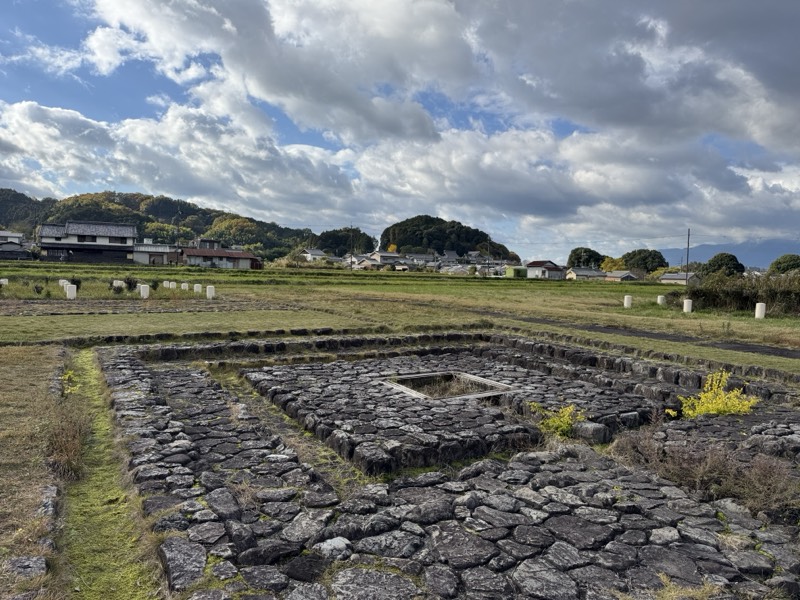 Asuka-Fujiwara World Heritage: All 19 Component Sites and How to Visit Them, with Half-Day, One-Day and Two-Day Routes"Asuka-Fujiwara" was inscribed on the World Heritage List in 2026. We list all 19 component sites with their…
 Asuka's Valley of the Kings: imperial tombs within walking distance of the stationAround Kintetsu Asuka Station, in Hirata, Noguchi and Koshi, a number of kofun said to be the tombs of…Whose Tomb Is the Mausoleum of Emperor Kinmei?Several theories have been put forward about who is buried in the largest keyhole-shaped tomb in Asuka…