
Home/Columns/The record of a robbery that saved a tomb: the Mausoleum of Emperor Tenmu and Empress Jitō
Published
Very few imperial tombs can be attributed to their occupants with near certainty. This one can because the investigation report from a tomb robbery in 1235 survived.

Walking around Asuka, you will see Imperial Household Agency notice boards again and again. Yet the occupants named on them often differ from the occupants that archaeology points to.
Kengoshizuka Kofun is regarded as the likely tomb of Empress Saimei, but the officially designated tomb is a different kofun in Takatori Town. Nakaoyama Kofun is thought to be the tomb of Emperor Monmu, but the official designation is Kurihara Tsukaana Kofun.
Among them, only the Mausoleum of Emperor Tenmu and Empress Jitō is considered almost certain as to its occupants. As a kofun (ancient burial mound), it is known as Noguchi no Ōbo.
The reason it could be confirmed is a little unusual: it was robbed.
In the spring of 1235, robbers broke into this tomb. The crime was carried out over two nights, on the 20th and 21st of the third month, and an entry about it appears in Meigetsuki, the diary of the poet Fujiwara no Teika.
The kebiishi, the police of the day, took action, caught the thieves and questioned them. The scene was inspected as well.
The record made at this time is the Aoki no Sanryōki. It compiles the confessions and the inspection of the scene: in effect, the case file for the crime.
According to the record, the inside of the stone chamber was lined with polished stone and looked like agate.
Inside lay a coffin of red-lacquered wood, and beside it was a silver cinerary urn. The coffin was Emperor Tenmu's, and the urn Empress Jitō's.
Empress Jitō is said to have been the first Japanese sovereign to be cremated. That is why hers was a container for bones. The husband in his coffin and the wife in her urn lay side by side in the same chamber.
The record says the thieves took the silver urn and scattered the remains inside it.
There are almost no cases in which the interior of a kofun was written down in the language of its time. This one document would later prove decisive.
As time went on, it was forgotten which kofun was whose tomb. Records were lost, and only local names remained.
In the Edo period (1603–1868), the joint tomb of Emperor Tenmu and Empress Jitō was not thought to be Noguchi no Ōbo. Gojōno Maruyama Kofun (Mise Maruyama Kofun) in Kashihara City was assigned that role.
Then, in 1862, the shogunate carried out repairs to the imperial tombs, known as the Bunkyū Repairs. At that time Noguchi no Ōbo was repaired as the tomb of Emperor Monmu.
In other words, at the end of the Edo period this tomb bore the name of a different emperor.
The turning point came in the Meiji era.
In 1880 a copy of the Aoki no Sanryōki was found at Kōzan-ji Temple in Toganoo, Kyoto. A case file from 645 years earlier had turned up in a temple storehouse.
What it described, the structure of the stone chamber, the red-lacquered coffin, the silver urn, matched the condition of Noguchi no Ōbo.
On 1 February the following year, 1881, Noguchi no Ōbo was officially redesignated as the joint tomb of Emperor Tenmu and Empress Jitō. The name "Tomb of Emperor Monmu" was dropped, and the tomb was restored to its true occupants.

To put it in order, this is how it went.
The tomb was broken into and the remains scattered. The record of the investigation was copied at a temple and lay forgotten for more than six hundred years. Its discovery made this one of the few imperial tombs whose occupants are known.
Tomb robbery, the worst thing that can happen to a tomb, ended up confirming who was buried there. Had there been no incident in 1235, this mound might still be called the Tomb of Emperor Monmu today.

The story gets one step more complicated.
Gojōno Maruyama Kofun, which in the Edo period was thought to be the tomb of Tenmu and Jitō, is now a leading candidate in the theory that it is the tomb of Emperor Kinmei.
Meanwhile, what the Imperial Household Agency manages as the Mausoleum of Emperor Kinmei is Umeyama Kofun in Hirata, Asuka Village. A notice board reading "Emperor Kinmei, Hinokuma no Sakaai no Misasagi" stands here too.
Correct one mix-up and another appears next door. The designation of imperial tombs sits within a chain like this.
Noguchi no Ōbo is an octagonal mound, about 37 m across from side to opposite side and about 7.7 m high, built in five tiers.
The octagon was a shape used only for imperial tombs of this period. Today, though, the mound is covered in trees, and you cannot make out its shape from outside.
It is managed by the Imperial Household Agency, and the mound is off-limits. You pay your respects from in front of the torii gate.
About 10 minutes on foot from Kintetsu Asuka Station. Just to the north are Oni no Manaita and Oni no Setchin, and from there you can walk on to the Mausoleum of Emperor Kinmei and the Saruishi (Monkey Stones). Umeyama Kofun, on the other side of the mix-up, is about 10 minutes away.
RELATED SPOT
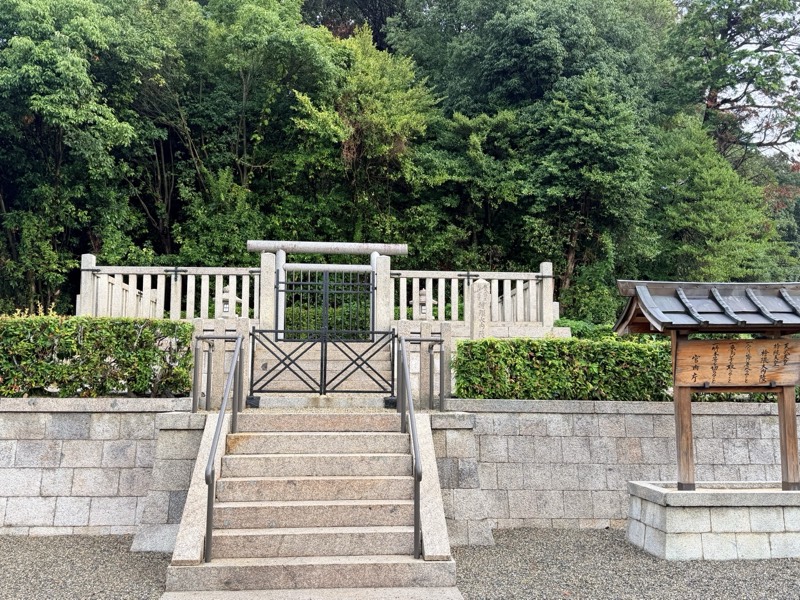
天武・持統天皇陵
One of the few octagonal imperial tombs whose occupants can be confirmed from written records.
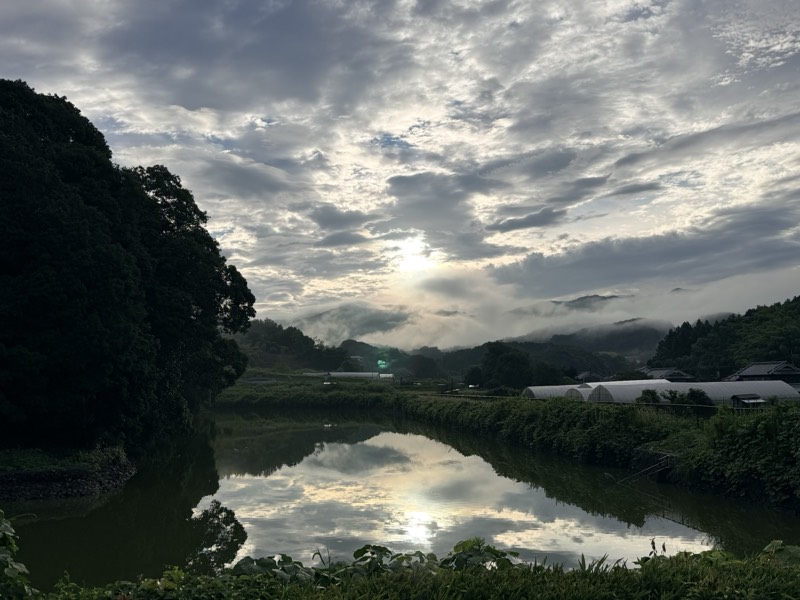
欽明天皇陵
One of the few large keyhole-shaped burial mounds in Asuka Village.
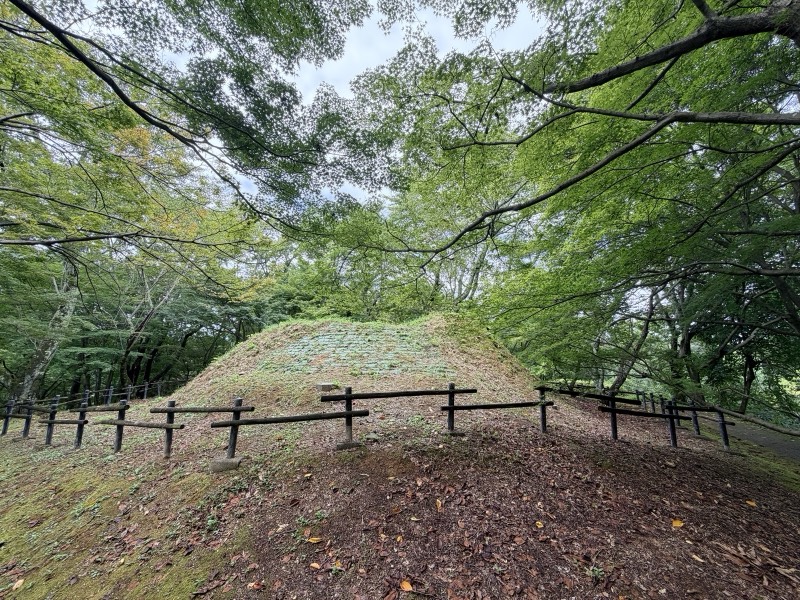
中尾山古墳
A small octagonal mound thought to be the tomb of the cremated Emperor Monmu.
RELATED COLUMN
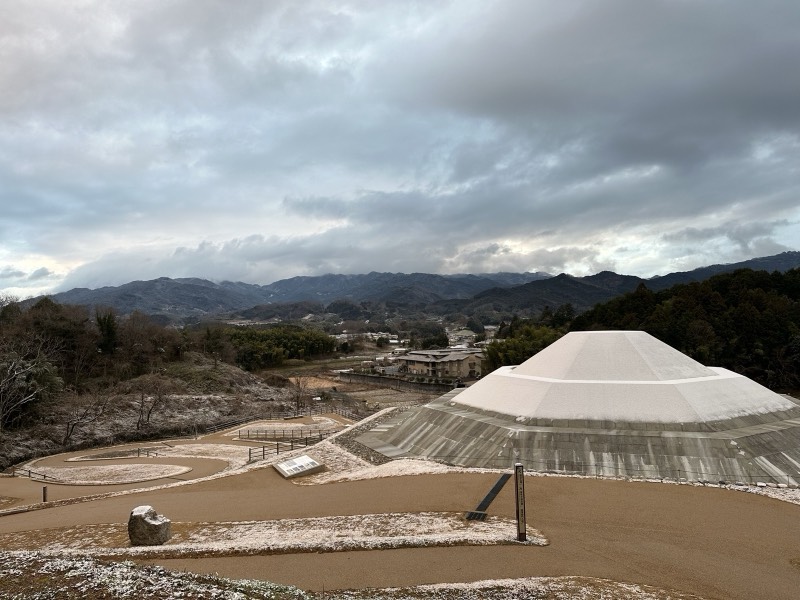 Octagonal Tombs: A Shape Reserved for EmperorsNeither round nor square, but a mound with eight sides. For about sixty years, from the mid-7th to the early…Asuka's Valley of the Kings: imperial tombs within walking distance of the stationAround Kintetsu Asuka Station, in Hirata, Noguchi and Koshi, a number of kofun said to be the tombs of…Whose Tomb Is the Mausoleum of Emperor Kinmei?Several theories have been put forward about who is buried in the largest keyhole-shaped tomb in Asuka…