
Published
In 600 the first envoys sent to the Sui court in China came home having been told by the emperor that their ways made no sense. Within a hundred years, this country had become a state governed by ritsuryō law codes.
In 600, envoys were sent from Wa (as China called Japan) to the Sui dynasty.
Yet this mission does not appear in the Nihon Shoki (Japan's oldest official chronicle, compiled in 720). We know of it only from the account of Wa in the Book of Sui, a Chinese official history.
According to the Book of Sui, Emperor Wen of Sui asked the envoy how the country of Wa was governed. The envoy replied: the king of Wa regards Heaven as his elder brother and the Sun as his younger brother. He comes out to conduct affairs of state before dawn, and when the sun rises he withdraws, saying, "I leave the rest to my younger brother."
Hearing this, Emperor Wen said, "This is utterly unreasonable." That is, it made no sense at all. The record says he then admonished them to change their ways.
Sui was a new empire that had unified China only a dozen or so years earlier. It was putting in place systems to run the country through law and institutions: the equal-field system, the so-yō-chō taxes in grain, labour and goods, and the imperial examinations.
Seen from that emperor's point of view, the Wa envoy's answer explained no system at all. Who held which office, on what basis taxes were collected, by what laws cases were judged: none of this could be answered.
What Emperor Wen faulted, it seems, was less barbarous custom as such than "being unable to explain how the country works".
One view holds that the Nihon Shoki leaves out this mission because it was an embarrassing memory.
What followed moved quickly.
In 603 came the Twelve Cap Ranks. Twelve ranks were established by dividing each of six virtues (virtue, benevolence, propriety, faith, righteousness and wisdom) into greater and lesser, and they were shown by the colour of one's cap. The key point is that these ranks were given to individuals and could rise with merit. Until then, status had been tied to the uji, the clan or lineage group.
In 604 came the Seventeen-Article Constitution. It set out the proper attitude for officials and was not a legal code. But articles such as "Harmony is to be valued" and "When you receive an imperial command, obey it without fail" assume a bureaucracy centred on the emperor rather than a coalition of powerful clans.
Both are recorded in the Nihon Shoki as events of Empress Suiko's reign, and their dates are debated. Even so, it is certain that within a few years of the admonition of 600, the court set about creating "a system that could be explained".
Then, in 607, Ono no Imoko crossed to Sui.
The opening of the letter he carried is famous: "The Son of Heaven in the land where the sun rises sends this letter to the Son of Heaven in the land where the sun sets. We trust you are in good health."
The Book of Sui records that Emperor Yang was displeased and said, "Among the letters of the barbarians there is one that is discourteous. Do not bring such things to me again."
The problem was that the sender called himself Son of Heaven. In the Chinese view of the world, there is only one Son of Heaven. There is also a reading, however, that "where the sun rises" and "where the sun sets" were merely conventional ways of saying east and west.
What is worth noting is that, angry as he was, Emperor Yang sent Pei Shiqing to Wa the following year, 608, as an envoy in return. Relations were not broken off.

In 608, when Pei Shiqing returned home, Imoko crossed the sea again. Eight students and student monks went with him.
Among them were Min, Takamuko no Kuromaro and Minabuchi no Shōan, men who would later shape events in Asuka.
Envoys simply went and came back, but students stayed on. Min returned in 632, and Takamuko no Kuromaro and Minabuchi no Shōan in 640. They spent more than thirty years abroad. During that time the Sui dynasty fell and the Tang took its place, so they witnessed at first hand how a new dynasty rebuilt its institutions.
One way to see it is that the court went after the answers the first envoy could not give by sending people to learn them.
Minabuchi no Shōan opened a school in Asuka. The Nihon Shoki records that Prince Naka no Ōe and Nakatomi no Kamatari studied there and talked together on the road to and from it.
In 645 came the Isshi Incident, in which Soga no Iruka was killed, five years after Shōan's return.
After the coup, Min and Takamuko no Kuromaro were appointed kuni no hakase, "national scholars", a post entrusted with designing the new government. The two men who had seen the institutions of Tang China were placed at its centre.
The next year, 646, the Taika Reform Edict was issued: public ownership of land and people, division of the country into provinces and districts, household registers and the allotment of rice fields, and the so-yō-chō taxes. The very items that could not be explained in 600 are all listed there.
It has been pointed out, however, that the text of the edict may have been rewritten using terms from a later period. How far the policies it announced were actually put into effect at the time is not known.

In 660, under Empress Saimei, a rokoku (water clock) was set up at Mizuochi in Asuka. The Nihon Shoki says Prince Naka no Ōe had it made.
A clock is an instrument of the state. At what hour officials report for duty, at what hour they change shifts: the state fixes the time and announces it with bells and drums. The offices of a ritsuryō state run on systems like this.
Then, in 663, came the Battle of Hakusukinoe (Baekgang). The army sent to help the Korean kingdom of Baekje was crushingly defeated by the allied forces of Tang and Silla.
After this defeat, domestic reorganisation advanced rapidly. Defensive earthworks (mizuki) and mountain fortresses were built, and in 670 a nationwide household register, the Kōgo Nenjaku, was compiled. The state would know who lived where and in what numbers: the foundation for taxation and conscription.
Pressure from outside had hurried on the building of institutions.

After the Jinshin War of 672, Emperor Tenmu came to the throne.
In 684 came the Yakusa no Kabane, the "eight hereditary titles", by which the state redefined the ranking of the clans. In 689 the Asuka Kiyomihara Code came into force. In 690 the Kōin Nenjaku register was compiled, and from then on household registers were to be drawn up every six years.
Once the institutions were in place, they needed a container. The old practice of moving the palace with each new sovereign left no room for the growing number of government offices.
In 694 Empress Jitō moved to Fujiwara-kyō. With streets laid out in a grid and the palace set at the centre, it was Japan's first full-scale capital built on the jōbō grid system.

In 701 the Taihō Code was completed. With both ritsu (criminal law) and ryō (administrative law), it was the country's first systematic legal code.
In the same year, the era name Taihō was established. The following year, 702, an embassy to Tang China led by Awata no Mahito was sent, and it conveyed the country's name, "Nihon" (Japan), to the Tang court.
A legal code, an era name and a country name: exactly a hundred years after the country had been told its ways were "unreasonable" in 600.
The biggest change was in the principle of who land and people belonged to.
Until then, each powerful clan had its own land and its own people. The private estates were called tadokoro and the privately held people kakibe. Taxes and labour were taken by the clans from their own people, and part was passed on to the great king (ōkimi). The great king was something close to the leader of an alliance standing on top of these clans.
The Taika Reform Edict proclaimed public ownership of land and people: all land and all people belonged to the state. The principle was that private holdings by the clans would not be recognised.
If this went through, the structure of the country would change at its root. The state would know its people directly through household registers, allot them rice fields through the handen shūju system, and collect taxes directly as so-yō-chō. The clans that had stood in between were absorbed into the offices of provincial governor (kokushi) and district governor (gunji), working as officials of the state.
The country was divided into provinces, districts and villages, and provincial governors were sent out from the centre. From a system in which local clans each held their own domains, to a centralised state that ran the whole country under a single system with the capital at its head: this is what the ritsuryō state was.
People's status changed on the same principle. What had been decided by the clan you were born into became a court rank given to the individual; you took the office that matched your rank and received the pay that matched your rank. People were placed at a point in the system, recorded, and made replaceable.
The principles proclaimed did not simply go through as written, of course. District governors were drawn from local clans, and real power stayed rooted in the land. The handen shūju system, too, ran into difficulties within the 8th century. Even so, the fact that the official principle was established, that land and people belonged to the state, shaped the next thousand years.
An earlier column touched on why kofun (ancient burial mounds) stopped being built. The need to show power through the size of a tomb disappeared precisely because of this change. Status came to be decided within the system and displayed within the system.
Almost all the stages of this hundred years lie within this village.
At the Asuka Palace Site, remains show palaces built one on top of another, from the Itabuki Palace to the Kiyomihara Palace. It is said to be where the Isshi Incident took place.
At the Mizuochi Site are the foundations of the water clock, and at the Ishigami Site next door are the remains of facilities used to entertain envoys. They are thought to have been where the Emishi and Hayato peoples were feasted, and they date from the period when the forms for receiving guests as a state were being put in place.
And then the Fujiwara Palace Site. Today it is a wide grassland, with rapeseed flowers in spring and cosmos in autumn. Its quiet makes it hard to believe a grid-plan capital once stood here, but this was where the hundred years arrived.
The country that had been told it was "utterly unreasonable" had, a hundred years later, its own laws, its own era names and its own name.
RELATED SPOT
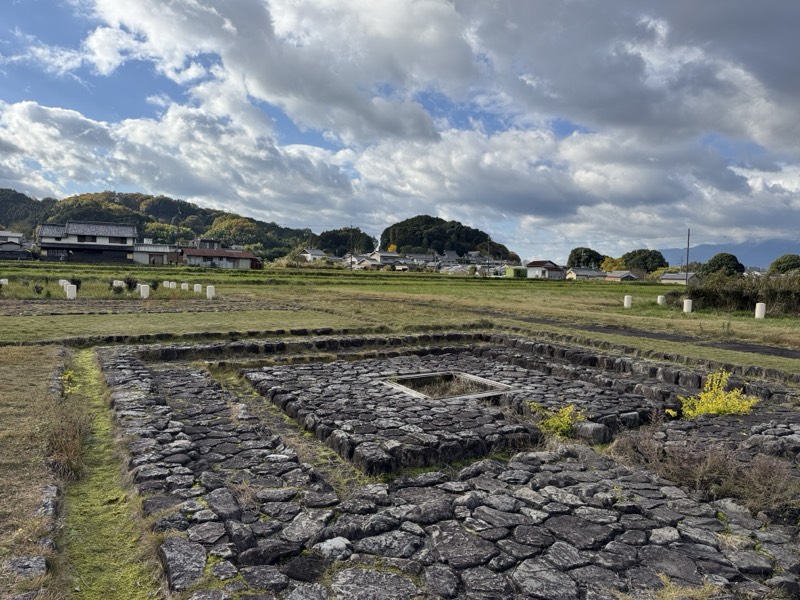
飛鳥宮跡(伝 飛鳥板蓋宮跡)
The political heart of Asuka, where several palaces were built one on top of another.
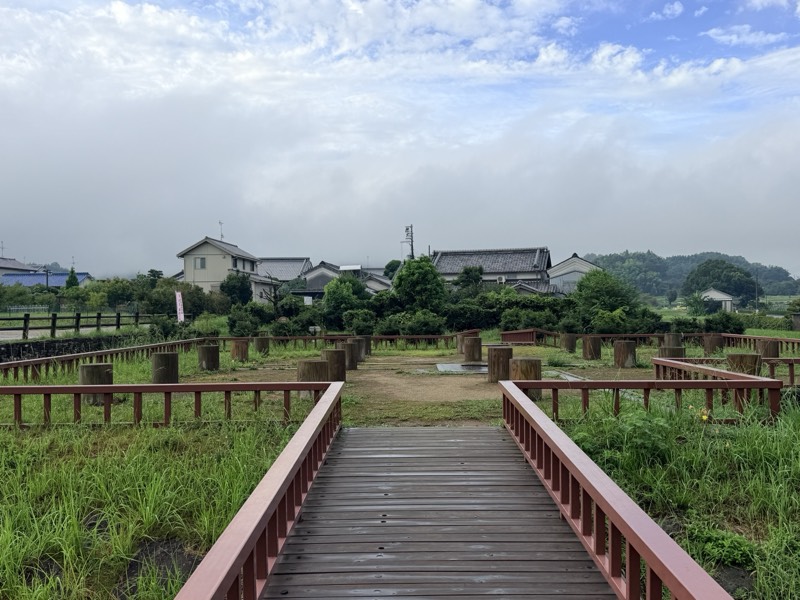
飛鳥水落遺跡
The site of Japan's first water clock, built by Prince Naka-no-Ōe.
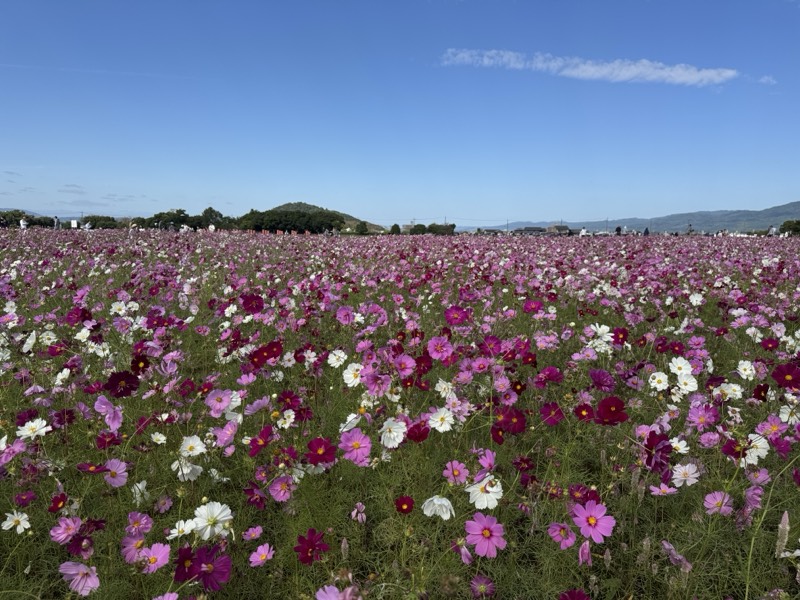
藤原宮跡
The heart of Japan's first full-scale planned capital, also known for its seasonal flower fields.
RELATED COLUMN
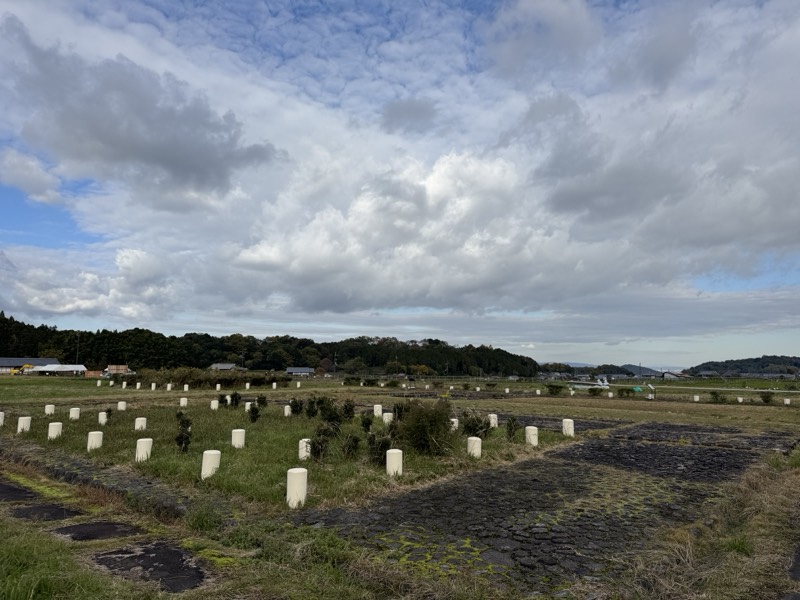 Whose Successor Was Empress Jitō? Tenmu's Empress, and Tenchi's DaughterAs the empress who completed the ritsuryō state (a state governed by law codes), she is usually spoken of in…
 A Century of Women Rulers: Empress Jitō and East Asia in Her TimeIn 690, the year Empress Jitō took the throne in Japan, Wu Zetian became emperor in Tang China. Half a…The Original Didn't Follow the Book: Fujiwara-kyō Seen from Chang'anFujiwara-kyō placed its palace at the centre of the capital, just as the Chinese classic the Rites of Zhou…