
Home/Columns/The Stone Wall on the Hill East of the Palace: 700 Metres of Sandstone at the Sakafuneishi Site
Published
In 1992, work on a walking path turned up a sandstone wall on the Sakafuneishi hill. Was the wall that ran around the hill a rampart for defence, or a wall meant to be seen?

In 1992 Asuka Village planned a walking path from Sakafuneishi to the Asuka Folk Museum. During the work, at a spot only about 50 metres northwest of Sakafuneishi, cut blocks of quartz diorite and a large number of yellow sandstone blocks came out of the ground. The work was stopped and digging continued, and the line of stones kept going. This was the discovery of the Sakafuneishi site.
Until then Sakafuneishi had been a mysterious stone lying alone in a bamboo grove on top of the hill. The discovery showed that it was part of a hill shaped by human hands. From the next year, 1993, the village set up a research committee and began survey excavations with national support. In a little over ten years the surveys reached their 25th season.
The order of work reconstructed from the excavations is as follows.
First the top of the hill was cut flat, and lower ground was built up with rammed earth. The slope was cut into terraces, and on them a single row of Asuka stone (quartz diorite) blocks 80 to 100 centimetres across was laid as a foundation. On top, brick-like cut blocks of sandstone about 30 × 20 × 15 centimetres were stacked. The sandstone came from near Mt. Toyoda in Tenri City; the faces of the lower courses, and the face and top of the highest course, were polished smooth, and the stones of the upper courses were cut at a slant.
Where best preserved, four courses survive today. From the fill behind the wall, it is estimated that there were originally seven or eight courses, a metre or more high. Layers of sandstone chips in the fill show that the blocks were given their final finish on the spot before being laid.
Later surveys showed that the wall ran around the middle of the hill for a total of more than 700 metres. Near the east end of the ridge, the foundation stones follow the contour and then turn at a right angle, climbing the ridge in steps. On the western slope, three more rows of stones were found further down. On its western side, the side facing the palace, the hill was ringed four times, counting the sandstone wall.
In its entry for 656, the Nihon Shoki says that Empress Saimei "piled up stones to make a wall on the hill east of the palace". A hill east of the Asuka Palace site; stone from Tenri. The excavation had found something that fits the entry exactly.
An ancient site with stone walls around the middle of a hill brings to mind the ancient hill forts. After the defeat at Baekgang in 663, Korean-style hill forts were built from Kyushu to the Inland Sea. One view sees the Sakafuneishi site as part of a fort enclosing the hill east of the palace, and some research imagines a much larger fort enclosing everything from east of the palace to Tōnomine.
The excavators, however, doubt this. The wall is low and vertical, made of cut sandstone, and polished on its face. In front of it there is only a narrow strip of level ground, and no post holes have been found. The construction, they argue, put more weight on how the wall looked when seen from the palace below than on strengthening defence. Similar as it is to hill forts in setting and technique, it is thought to have been something different in nature.
On the ridge further east of the hill, on the other hand, a fence of earth-fast posts with post holes 1.5 metres square was found running along the ridge line. A similar fence has been found at the nearby Yatsuri Makito site, and it has been suggested that these were defences around Asuka, but their date and nature are still unknown.
The Nihon Shoki says people of the time mocked the work: "They make a hill of stone. As fast as they make it, it will fall down of itself."
The wall did fall. Pottery of the late 7th century has been found in the soil of the collapsed wall, and it is thought to have fallen in the Hakuhō Nankai earthquake of the 10th month of 684, the great earthquake of which the Nihon Shoki says "mountains collapsed and rivers surged". Apart from part of the western slope, there is no sign it was rebuilt, and the fallen sandstone was later taken away and used elsewhere. The mockery turned out, in the end, to be right.

In 2000 a water facility including the turtle-shaped stone basin was found in the valley north of the hill. The wall on the hill and the water facility at the bottom of the valley are now treated together as the Sakafuneishi site, and in 2004 the name of the historic site was changed from "Sakafuneishi" to "Sakafuneishi Site". The valley facility is an enclosed space shut in by high ridges and stone walls, and the leading view is that it was a place where the ruler performed rites with only a few people present.
East of the valley facility there is a flight of eight stone steps, and beyond it the way turns at a stone-paved terrace and climbs further up the ridge. Water rites in the valley, then up the steps to Sakafuneishi on the hilltop: the top and the bottom of the hill may have been built as a single ritual space. In May 2004 an area of about 31,000 square metres was recommended for designation as a historic site.
RELATED SPOT
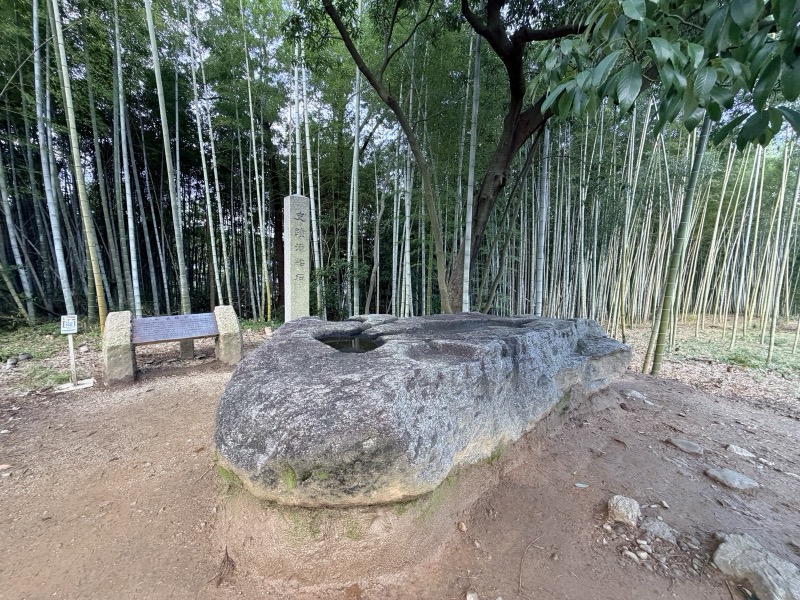
酒船石
A mysterious stone carved with circles and channels, lying in a bamboo grove on top of a hill.
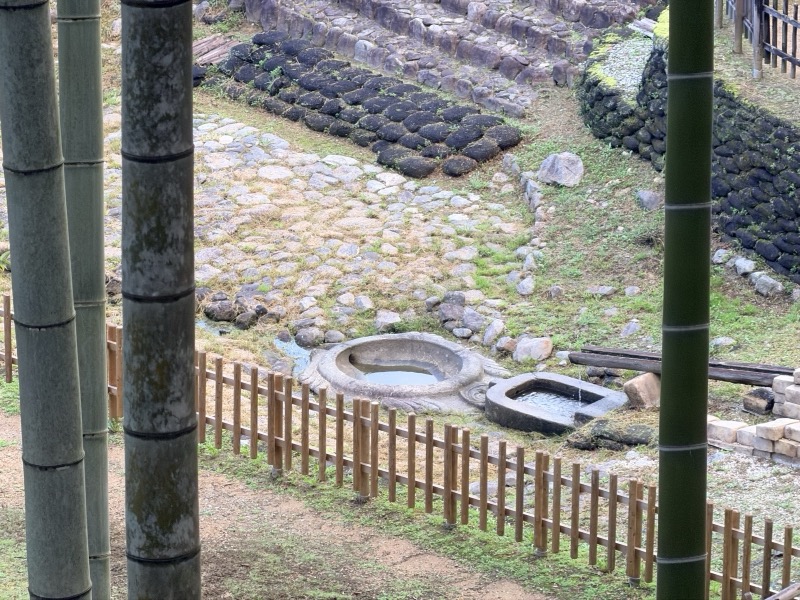
亀形石造物
A ritual site from the reign of Empress Saimei, with stonework designed to channel water.
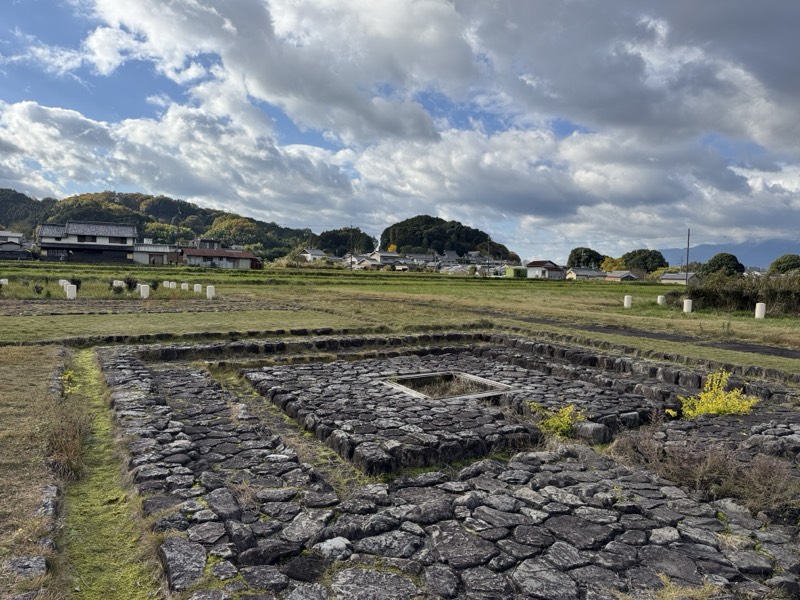
飛鳥宮跡(伝 飛鳥板蓋宮跡)
The political heart of Asuka, where several palaces were built one on top of another.
奈良県立万葉文化館
A centre for ancient culture built around the Man'yōshū.
RELATED COLUMN
 The "Canal of Madness": Two Hundred Boats Bringing Tenri Stone to AsukaEmpress Saimei had a canal dug and brought stone from a mountain in Tenri to Asuka by boat. People mocked it…
 Futatsuki-no-miya: The "Heavenly Palace" Built on the Summit of TōnomineEmpress Saimei had a building put up on the summit of a mountain east of Asuka, beside two zelkova trees. It…Was Futatsuki-no-miya a Fortress? Unrest After the Isshi Incident and the "Kan" on the MountainFutatsuki-no-miya, which Empress Saimei built on the summit of Tōnomine, has been called a palace of the…